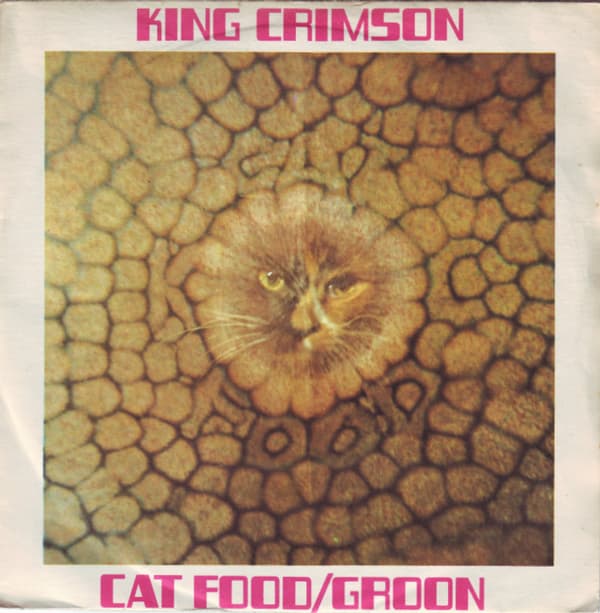
This single represents a fascinating, jagged pivot point in the King Crimson timeline.
While their debut was defined by the massive, symphonic weight of the Mellotron, Cat Food introduces a wiry, urban energy driven by Keith Tippett’s avant-garde piano clusters. It is a piece of art-rock that feels both sophisticated and slightly unhinged, like a cocktail party where the guests are starting to lose their minds.
The track is anchored by Greg Lake’s last great vocal performance for the group, delivering Peter Sinfield’s satirical lyrics with a sneer that perfectly matches the rhythmic bounce of the bass. On the flip side, Groon abandons the pop structure entirely for a dive into dissonant, improvisational jazz-rock.
It is a skeletal, challenging piece that showcases Robert Fripp’s growing interest in non-linear guitar figures and complex interplay with the rhythm section.
There is a cold, mathematical beauty to the way the instruments collide and repel one another. This is not music for relaxation; it is music for active, perhaps even forensic, listening.
Owning this release is essential for anyone who wants to understand how the band survived the collapse of its original lineup. It captures the moment where the Crimson sound became something more fluid, dangerous, and unpredictable.
It is the sound of a band shedding its skin in real-time, trading the grandeur of the court for the grit of the city streets and the abstraction of the jazz club.
Also reviewed byAllMusic
How does Cat Food / Groon sound next to the rest of King Crimson's catalogue?
This album stays in step with the catalogue across the board — no axis departs enough to be worth its own note. Hover the dots to see where each one sits.
Cassette uses generative AI to enrich its catalog. How we use AI →