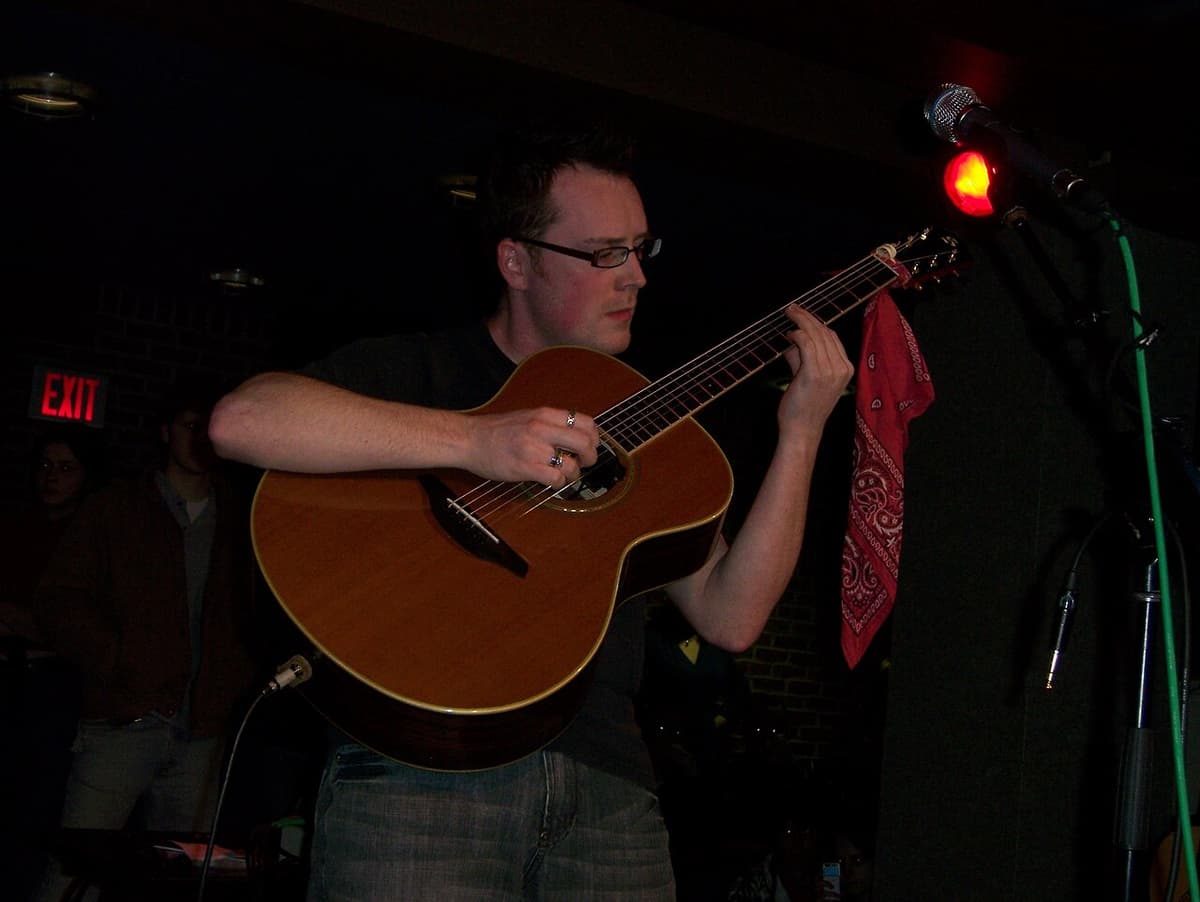
Alex de Grassi is a foundational figure in the evolution of modern fingerstyle guitar, specifically within the 'New Age' movement of the late 1970s and 1980s. While often grouped with his cousin and Windham Hill founder William Ackerman, de Grassi's work is distinguished by a significantly higher level of technical complexity and formal composition.
His style incorporates advanced classical techniques, jazz-influenced harmonies, and folk-derived open tunings, creating a sound that Tom Wheeler famously described as intimidatingly proficient. His career arc saw him move from the folk-centric early days of Windham Hill into more diverse explorations, including interpretations of pop standards and collaborations with bassist Michael Manring. Critically, he is viewed as a bridge between the primitive American guitar styles of John Fahey and the more percussive, modern innovations of Michael Hedges. His influence is pervasive in contemporary acoustic music, particularly in the way he popularized the use of the steel-string guitar as a solo orchestral instrument capable of intricate polyphony.



Shares reading, early_morning, acoustic guitar, modern classical (atmosphere)

Shares reading, neoclassical, early_morning, acoustic guitar (atmosphere)
Shares reading, chamber folk, cabin_in_woods, americana (atmosphere)
Shares neoclassical, acoustic guitar, crystalline, chamber folk (subgenre)
Shares early_morning, acoustic guitar, modern classical, cabin_in_woods (atmosphere)

Shares reading, neoclassical, acoustic guitar, chamber folk (atmosphere)
Cassette uses generative AI to enrich its catalog. How we use AI →