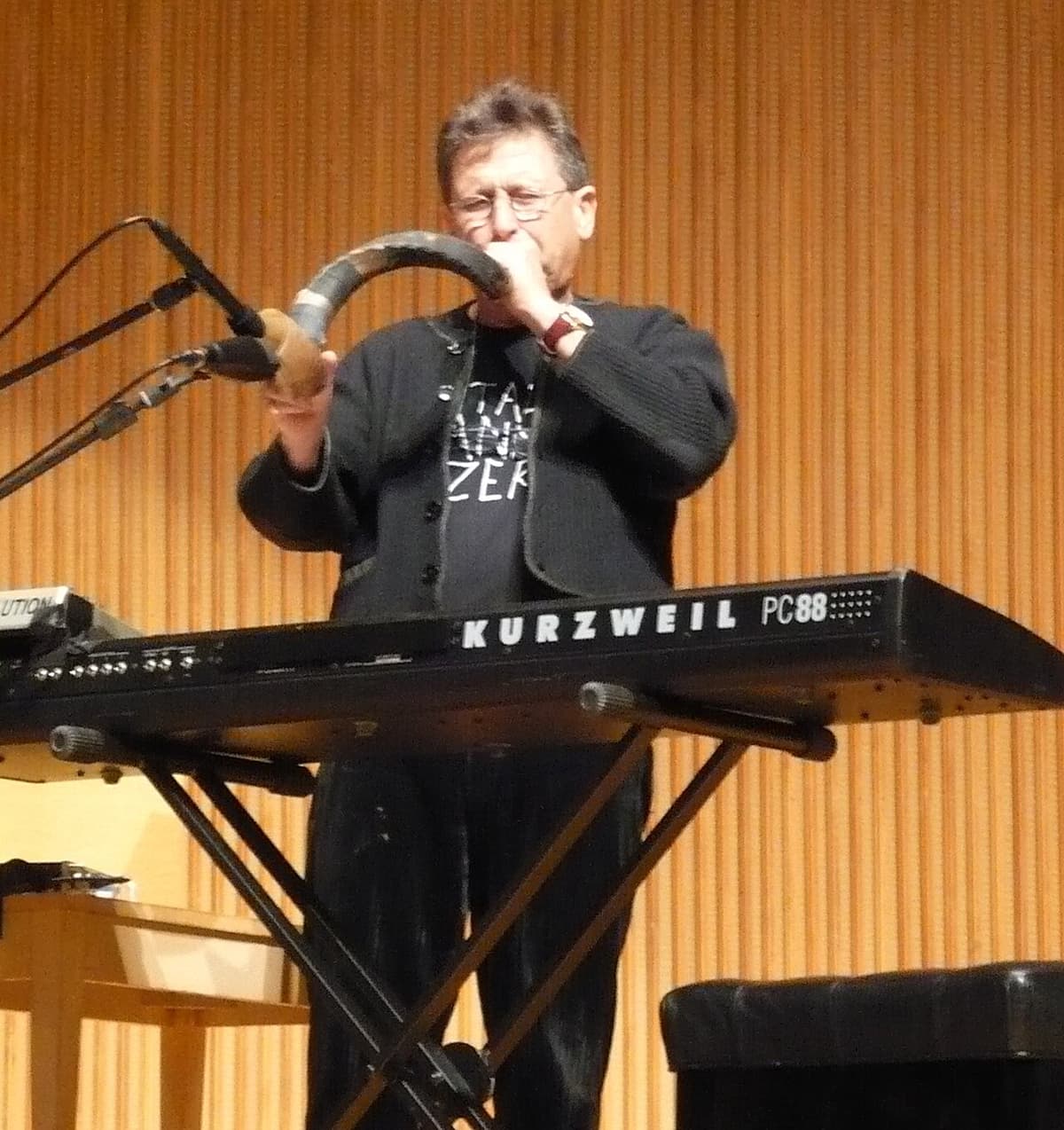
Alvin Curran
Lush environmental collages where synthesizers and field recordings breathe together. A master of organic electronics and patient, landscape-scale compositions.
Lush environmental collages where synthesizers and field recordings breathe together. A master of organic electronics and patient, landscape-scale compositions.
Alvin Curran creates music that feels less like a performance and more like an ecosystem. His work often blends the mechanical with the natural, using synthesizers to mimic the ebb and flow of tides or the distant call of animals. There is a profound sense of place in his recordings, whether he is capturing the resonant acoustics of a Roman cistern or the haunting blast of a maritime foghorn. It is music that invites you to listen to the world differently, blurring the line between intentional composition and the accidental beauty of everyday sound.
What truly distinguishes Curran is his ability to find the sacred in the mundane. He uses the shofar, bird calls, and street noise not as gimmicks, but as essential melodic voices. His piano works, particularly the 'Inner Cities' cycle, possess a meditative, almost architectural quality, where silence is just as important as the notes played. He manages to be both a rigorous avant-garde intellectual and a deeply emotional storyteller, creating soundscapes that feel ancient and futuristic all at once.
For those new to his massive catalog, 'Canti e vedute del giardino magnetico' is the essential starting point. It perfectly encapsulates his 'magnetic garden' aesthetic, blending gentle synth drones with evocative field recordings. If you prefer something more focused on solo performance, his piano cycles offer a more intimate but equally expansive experience. It is music for those who want to get lost in a sound that feels as wide as the horizon.
Alvin Curran (born December 13, 1938) is an American composer, performer, improviser, sound artist, and writer. He was born in Providence, Rhode Island, and lives and works in Rome, Italy. He is the co-founder, with Frederic Rzewski and Richard Teitelbaum, of Musica Elettronica Viva, and a former student of Elliott Carter. Curran's music often makes use of electronics and environmental found sounds. He was a professor of music at Mills College in California until 2006 and now teaches privately in Rome and sporadically at various institutions. He is an artistic advisor at the American Academy in Rome. His works include solo performance pieces such as Endangered Species, TransDadaExpress, and Shofar; radio works such as Crystal Psalms, Un Altro Ferragosto, I Dreamt John Cage Yodeling at the Zurich Hauptbahnhof, and Living Room Music; large-scale musical choreographic works such as Oh Brass on the Grass Alas, for 300 amateur brass-band musicians, and the Maritime Rites series of performances on and near water; sound installation works such as Magic Carpet, Floor Plan, The Twentieth Century, and Gardening with John; chamber music such as For Cornelius for piano, the trio Schtyx, the string quartet VSTO, the saxophone quartet Electric Rags II, the percussion quartet THEME PARK, a series of works for chorus SATB, and the work for chamber orchestra and video Circus Maximus; The Book of Beginnings for orchestra, youth orchestra, self-playing pianos, and cellphone app; and many collaborative dance and theater works. Since 1993, Curran has worked on Inner Cities, a growing series of solo piano pieces that together form one of the longest non-repetitive piano pieces ever written. Daniela Tortora has edited a book about his work, Alvin Curran Live in Roma (Die Schachtel 2010). In 2015 he published The Alvin Curran Fakebook, an atypical autobiography that includes photos, writings, and sketches alongside more than 200 scores and fragments ranging from raw sonic materials to conceptual musics and completed compositions. His articles have been published in the New York Times, Leonardo, The Contemporary Music Review, and Musiktexte, among others.
Cassette uses generative AI to enrich its catalog. How we use AI →


