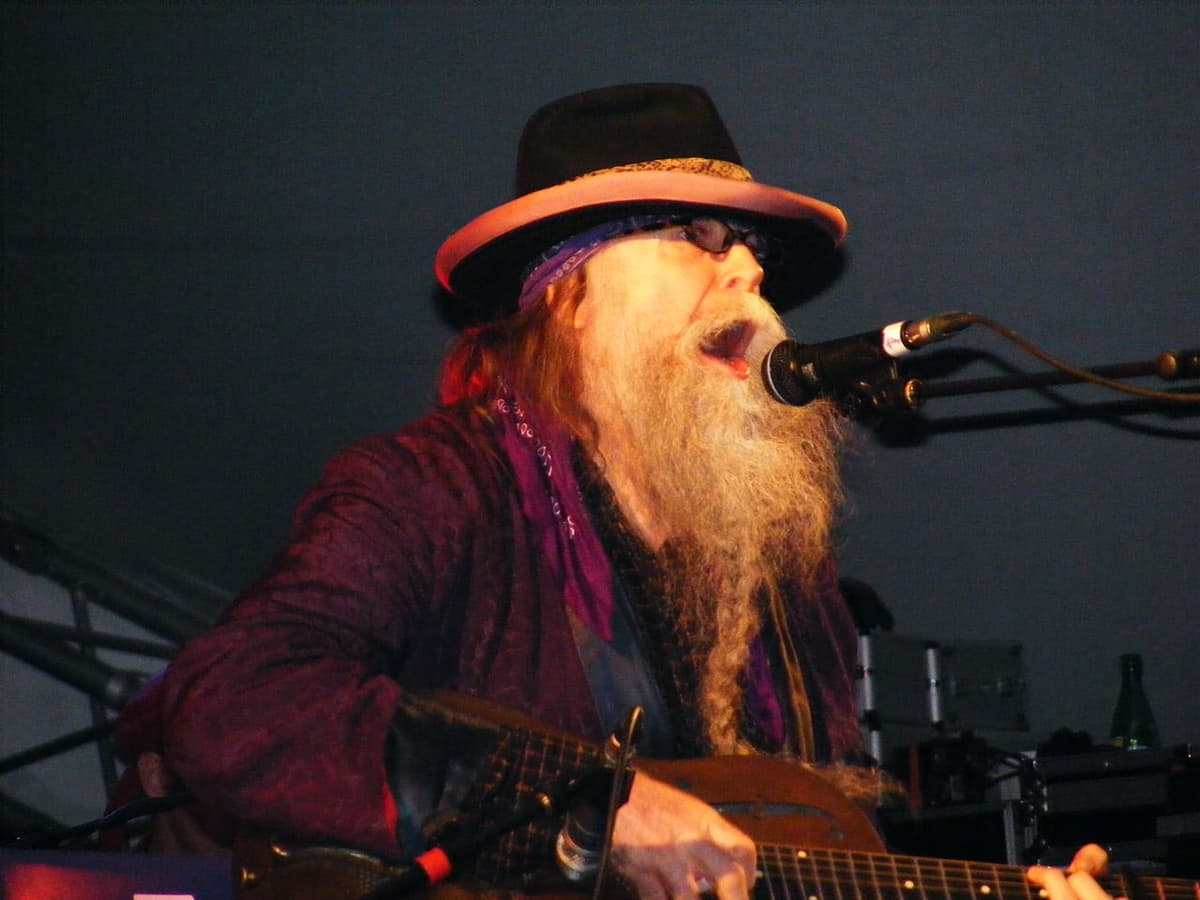
Baby Gramps
A surreal collision of vaudeville, throat singing, and resonator guitar. It sounds like a cartoon character busking on a 1920s street corner. Pure, eccentric energy.
A surreal collision of vaudeville, throat singing, and resonator guitar. It sounds like a cartoon character busking on a 1920s street corner. Pure, eccentric energy.
Baby Gramps is a singular figure in the American folk underground, a performer whose career spans over five decades of uncompromising eccentricity. Based primarily in the Pacific Northwest, he emerged from the 1960s folk revival but quickly diverged into a style that blends pre-war blues, vaudeville, and experimental vocal techniques.
His sound identity is defined by two primary factors: his use of an antique National Steel guitar played with unconventional 'elbow chording' and his 'Popeye-meets-didgeridoo' vocal delivery, which incorporates elements of Tuvan throat singing. Culturally, he occupies a space between street performer and avant-garde legend, having toured with diverse acts ranging from Phish and Béla Fleck to the 'Rogue's Gallery' sea chantey project produced by Hal Willner. Critical consensus views him as a vital link to the 'Old, Weird America' described by Greil Marcus, preserving forgotten novelty and labor songs through a lens of surrealist humor and palindromic wordplay. Despite his low-fidelity, outsider aesthetic, he is cited as a major influence in the Seattle music scene, recognized for bridging the gap between traditional folk and modern experimentalism.
Shares freak folk, anti-folk, acoustic folk, nasal (signature)
Shares freak folk, anti-folk, americana, stripped_back (signature)
Shares anti-folk, acoustic folk, bonfire, stripped_back (subgenre)
Shares freak folk, anti-folk, bonfire, chanting (signature)
Shares freak folk, acoustic guitar, acoustic folk, bonfire (signature)
Cassette uses generative AI to enrich its catalog. How we use AI →