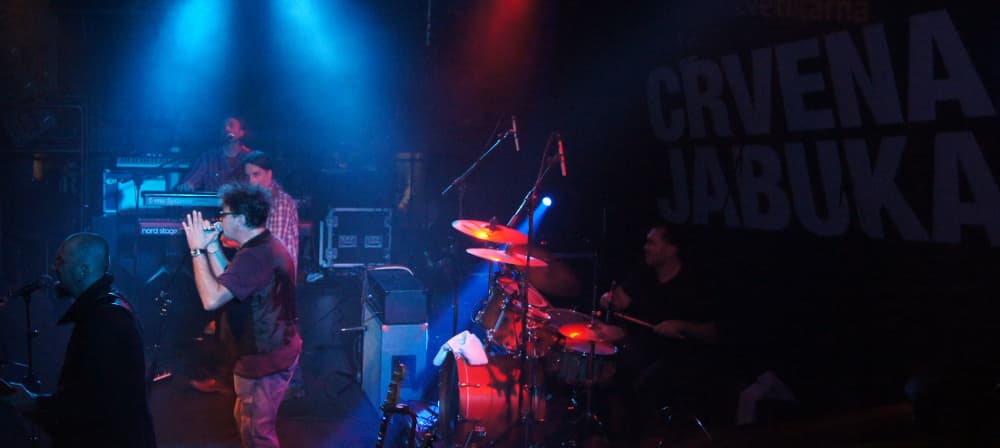
Crvena jabuka
Bittersweet pop rock with a distinctively raspy vocal and shimmering 80s synths. The sound of Sarajevo nostalgia and romantic longing for a time that never quite ends.
Bittersweet pop rock with a distinctively raspy vocal and shimmering 80s synths. The sound of Sarajevo nostalgia and romantic longing for a time that never quite ends.
Crvena Jabuka embodies a specific kind of Balkan romanticism that feels both deeply local and universally relatable. Their sound is defined by a warm, analog glow, where bright synth melodies and jangly guitars provide a backdrop for lyrics that almost always dwell on love, loss, and the passage of time. It is music that feels like a faded photograph: colorful enough to remember, but hazy enough to induce a gentle ache.
What truly sets them apart is the vocal delivery of Dražen Žerić, whose raspy, almost whispered tone brings an intimacy to even their most anthemic pop songs. Unlike the aggressive rock of their contemporaries, their music maintains a soft-focus lens, blending the melodic sensibilities of the 1960s British Invasion with the synth-heavy production of the 1980s Sarajevo scene. This combination creates a 'Sarajevo pop' aesthetic that is both catchy and profoundly melancholic.
Start with their 1986 self-titled debut for the raw energy of their early days, then move to 'Sanjati' to hear the band at their melodic peak. Their music is the perfect companion for moments of reflection, offering a comforting, melodic space to sit with memories of old friends and past loves.
Crvena Jabuka (transl. Red Apple) is a pop rock band originally formed in Sarajevo, SR Bosnia and Herzegovina, SFR Yugoslavia in 1985, and since 1994 based in Zagreb, Croatia. The group gained nationwide popularity during its initial run, and has continued to enjoy success in former Yugoslav republics since the band's 1994 reformation. The band's forming members, vocalist and guitarist Dražen Ričl "Para" and guitarist Zlatko Arslanagić "Zlaja", were in the early 1980s involved in the Sarajevo-based New Primitivism subcultural movement. Influenced by the 1960s British rock, the two formed Crvena Jabuka with keyboardist Dražen Žerić "Žera", drummer Darko Jelčić "Cunja" and bass guitarist Aljoša Buha. The band's self-titled debut album, released in 1986, was an instant commercial success, bringing large attention of the public and the media to the band. On 18 September 1986, while on their way to Mostar to hold the first concert on the album promotional tour, the members of the group were involved in a traffic accident, in which Ričl and Buha lost their lives. After the accident, the remaining three members, Arslanagić, Žerić and Jelčić, decided to continue as Crvena Jabuka, releasing the band's second album Za sve ove godine in 1987, but without giving interviews or holding promotional performances. They made a full-scale comeback to the scene with the 1988 album Sanjati, Žerić taking over the vocal duties and Arslanagić taking over the role of the band's leader and songwriter. The album was recorded with a new member, multi-instrumentalist Nikša Bratoš, who would in the following years also be in charge of album production. The group released two more highly successful studio albums, enjoying large popularity on the late 1980s Yugoslav rock scene, before the outbreak of the Bosnian War forced them to end their activity in 1992. In 1994, Žerić, Jelčić and Bratoš reformed Crvena Jabuka in Zagreb. The group continued their career collaborating with external songwriters, most prominently Zlatan Fazlić, Saša Lošić, Miroslav Drljača "Rus" and Dino Šaran, scoring a number of hits during the following years and renewing their popularity in former Yugoslav republics. On their later releases, the band made a shift to more pop-oriented sound, recording a number of duets with prominent acts from former Yugoslav republics. Since Jelčić's departure in 2017, Žerić has remained the only original member of the band.
Shares pop rock, soft rock, indie pop (subgenres); analog warmth, studio polished, reverb heavy (production style)
Shares pop rock, soft rock, indie pop (subgenres); nostalgic, bittersweet, romantic (moods)
Shares pop rock, soft rock, indie pop (subgenres); studio polished, analog warmth, layered dense (production style)
Shares pop rock, new wave, soft rock (subgenres); analog warmth, studio polished, layered dense (production style)
Shares pop rock, soft rock, indie pop (subgenres); analog warmth, studio polished, reverb heavy (production style)
Shares nostalgic, bittersweet, romantic (moods); analog warmth, studio polished, reverb heavy (production style)
Shares nostalgic, bittersweet, romantic (moods); pop rock, soft rock, indie pop (subgenres)
Shares pop rock, soft rock (subgenres); studio polished, analog warmth, layered dense (production style)
Shares pop rock, soft rock (subgenres); nostalgic, bittersweet, melancholic (moods)
Shares pop rock, nostalgic, soft rock, romantic (signature)
Shares pop rock, soft rock, romantic, coffee shop (signature)
Cassette uses generative AI to enrich its catalog. How we use AI →