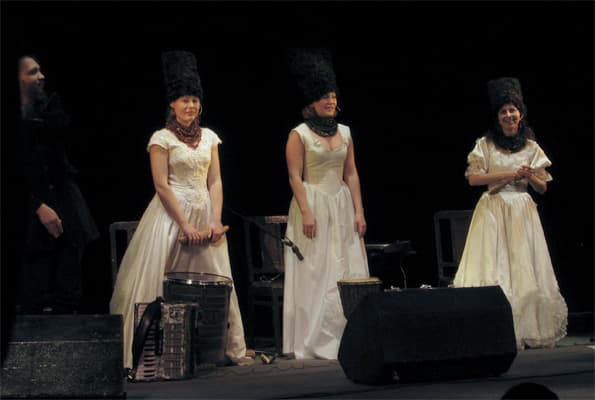
DakhaBrakha
Theatrical Ukrainian folk that collides ancient polyphonic singing with cello loops and tribal drums. Intense, haunting, and utterly singular 'ethnic chaos'.
Theatrical Ukrainian folk that collides ancient polyphonic singing with cello loops and tribal drums. Intense, haunting, and utterly singular 'ethnic chaos'.
DakhaBrakha sounds like a ritual unearthed from a future-past. It is built on the 'white voice' singing style of Eastern Europe, but stripped of its polite museum trappings and injected with the raw energy of avant-garde theater. The music is anchored by a deep, rhythmic cello and a vast array of global percussion that creates a hypnotic, almost industrial pulse beneath soaring, bird-like vocal harmonies.
What makes them truly distinctive is their 'ethnic chaos' philosophy. They don't just play folk songs; they deconstruct them. You will hear a traditional village lament suddenly pivot into a hip-hop beat or a minimalist piano line that feels like Philip Glass lost in the Carpathian Mountains. Their visual presence, featuring tall lamb's wool hats and traditional dress, is inseparable from the sonic experience, lending a sense of high-stakes drama to every note.
Start with the album 'Light' for their most accessible entry into this world, or 'Alambari' to hear how they have refined their cinematic, globe-trotting sound. It is music for people who want to feel the weight of history and the thrill of the experimental simultaneously.
DakhaBrakha are a Ukrainian folk music quartet which combines the musical styles of several ethnic groups. They were a winner of the Sergey Kuryokhin Contemporary Art Award in 2009 and the Shevchenko National Prize in 2020. DakhaBrakha are a project of the Dakh Contemporary Arts Center, led by Vladyslav Troitskyi and born as a live theater music crew. Troitskyi continues to be the band's producer. Members of DakhaBrakha participate in the centre's other projects, notably in the all-female cabaret project Dakh Daughters, as well as in the annual Gogolfest festival.
Cassette uses generative AI to enrich its catalog. How we use AI →


