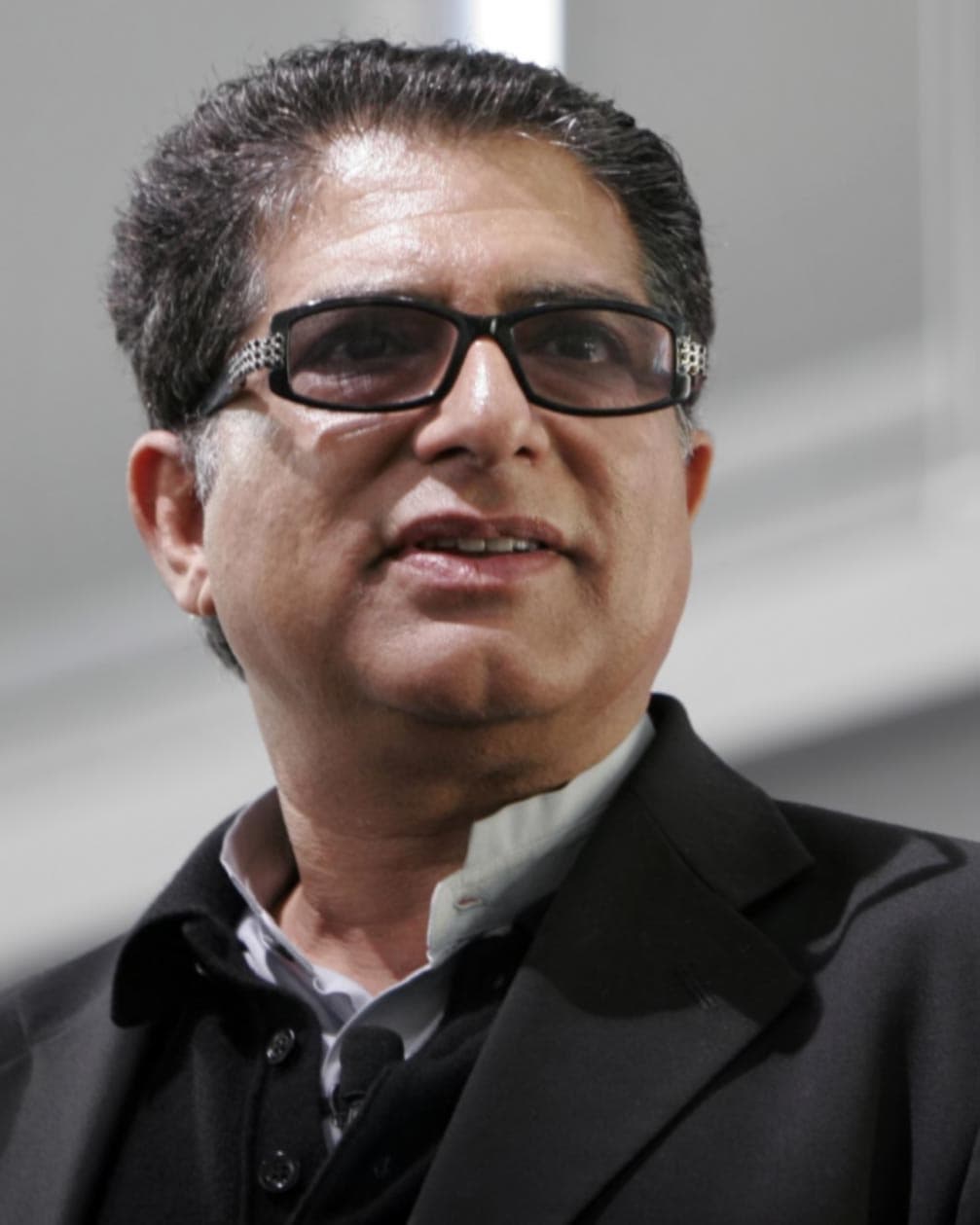
Deepak Chopra
Soothing spoken-word guidance floating over lush, cinematic ambient textures. A sonic sanctuary for meditation, deep rest, and mental clarity.
Soothing spoken-word guidance floating over lush, cinematic ambient textures. A sonic sanctuary for meditation, deep rest, and mental clarity.
Deepak Chopra's musical output is less about performance and more about creating a functional sonic environment. It features his unmistakable, resonant baritone voice delivering spiritual insights and guided meditations. This narration is typically cradled by high-fidelity New Age production, characterized by slow-moving synthesizer pads, gentle Indian classical instrumentation like the bansuri flute or sitar, and a deep, immersive use of reverb that makes the voice feel as if it is originating from within the listener's own mind.
What sets this work apart is the intentionality of the pacing. The music is designed to synchronize with the human breath, utilizing long, sustained notes and a lack of aggressive transients to prevent the startle reflex. Unlike traditional ambient music which may be purely textural, Chopra's work uses the voice as a primary melodic instrument, treating spoken syllables with the same care a composer might give to a lead violin, often layering multiple vocal tracks to create a 'chorus of wisdom' effect.
For those new to his catalog, 'A Gift of Love' is the essential entry point. It features famous actors reciting Rumi's poetry over world-ambient grooves, providing a more musical and collaborative experience than his purely instructional meditation albums. It serves as a bridge between high-concept spirituality and accessible, late-night chillout music.
Deepak Chopra (; Hindi: [diːpək tʃoːpɽa]; born October 22, 1946) is an Indian-American author, new age guru, and alternative medicine advocate. A prominent figure in the New Age movement, his books and videos have made him one of the best-known and wealthiest figures in alternative medicine. In the 1990s, Chopra, a physician by education, became a popular proponent of a holistic approach to well-being that includes yoga, meditation, and nutrition, among other new-age therapies. Chopra studied medicine in India before emigrating in 1970 to the United States, where he completed a residency in internal medicine and a fellowship in endocrinology. As a licensed physician, in 1980, he became chief of staff at the New England Memorial Hospital (NEMH). In 1985, he met Maharishi Mahesh Yogi and became involved in the Transcendental Meditation (TM) movement. Shortly thereafter, Chopra resigned from his position at NEMH to establish the Maharishi Ayurveda Health Center. In 1993, Chopra gained a following after he was interviewed about his books on The Oprah Winfrey Show. He then left the TM movement to become the executive director of Sharp HealthCare's Center for Mind-Body Medicine. In 1996, he cofounded the Chopra Center for Wellbeing. Chopra claims that a person may attain "perfect health", a condition "that is free from disease, that never feels pain", and "that cannot age or die". Seeing the human body as undergirded by a "quantum mechanical body" composed not of matter but energy and information, he believes that "human aging is fluid and changeable; it can speed up, slow down, stop for a time, and even reverse itself", as determined by one's state of mind. He claims that his practices can also treat chronic disease. The ideas Chopra promotes have regularly been criticized by medical and scientific professionals as pseudoscience. The criticism has been described as ranging "from the dismissive to...damning". Philosopher Robert Carroll writes that Chopra, to justify his teachings, attempts to integrate Ayurveda with quantum mechanics. Chopra says that what he calls "quantum healing" cures any manner of ailments, including cancer, through effects that he claims are literally based on the same principles as quantum mechanics. This has led physicists to object to his use of the term "quantum" in reference to medical conditions and the human body. His discussions of quantum healing have been characterized as technobabble – "incoherent babbling strewn with scientific terms" by those proficient in physics. Evolutionary biologist Richard Dawkins has said that Chopra uses "quantum jargon as plausible-sounding hocus pocus". Chopra's treatments generally elicit nothing but a placebo response, and they have drawn criticism that the unwarranted claims made for them may raise "false hope" and lure sick people away from legitimate medical treatments.
Cassette uses generative AI to enrich its catalog. How we use AI →


