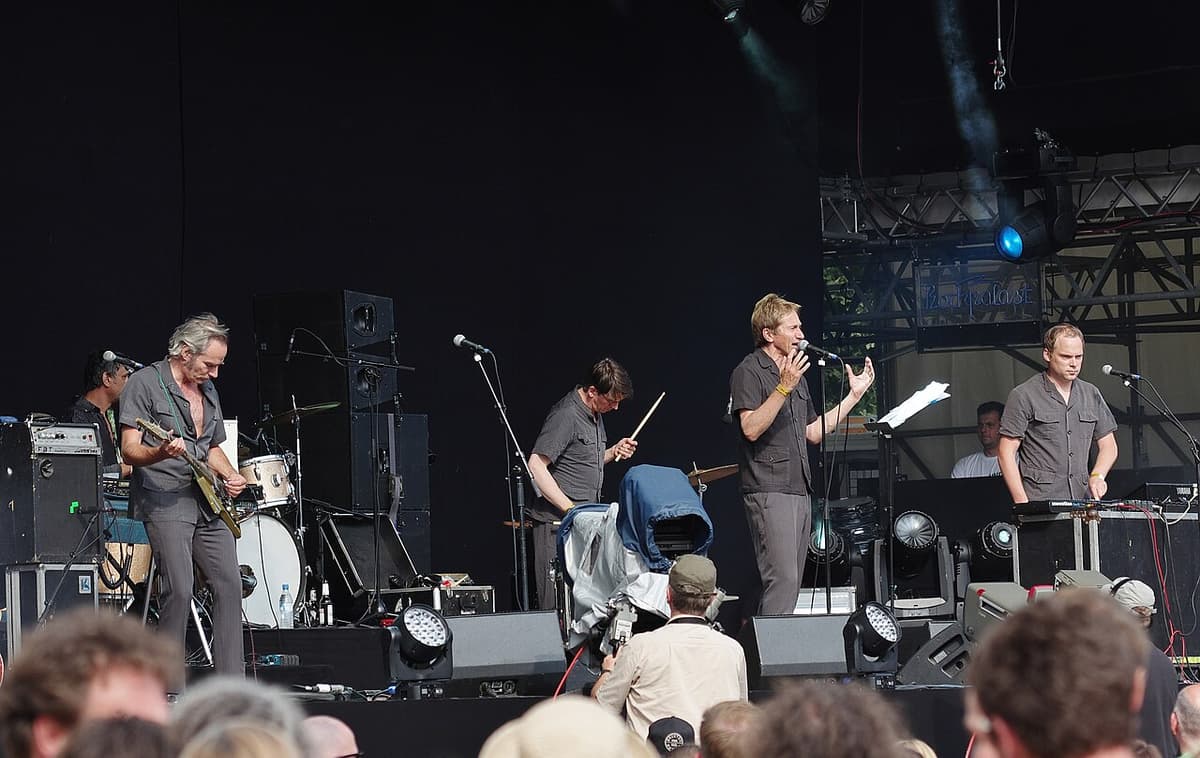
Die Goldenen Zitronen
Aggressive German punk that evolved into a restless, avant-garde collage of noise, satire, and electronics. Sharp, intellectual, and perpetually unclassifiable.
Aggressive German punk that evolved into a restless, avant-garde collage of noise, satire, and electronics. Sharp, intellectual, and perpetually unclassifiable.
Die Goldenen Zitronen sound like a riot happening inside an art gallery. They began as a bratty, high-energy punk outfit mocking the pop charts, but they quickly mutated into something far more complex. Their music is a jagged mixture of driving post-punk basslines, cheap electronic chirps, and vocals that oscillate between frantic shouting and coolly detached spoken word. It is music that feels intentionally unstable, as if the songs might fall apart or transform into a completely different genre at any moment.
What makes them truly distinctive is their 'anti-rockist' philosophy. While their peers in the German punk scene often stuck to three chords and leather jackets, the 'Lemons' embraced the chaotic and the experimental. They use synthesizers, samplers, and theatrical delivery to dismantle the tropes of rock music while simultaneously delivering some of the most biting social and political critiques in the German language. They are the bridge between the raw energy of 80s squat-punk and the intellectual depth of the Hamburger Schule.
To understand their trajectory, start with 'Fuck You' for their peak satirical punk energy, then move to 'Economy Class' to hear them begin their fascinating descent into electronic experimentation and abstract social commentary. It is essential listening for anyone who likes their music to have a high IQ and a short fuse.
Die Goldenen Zitronen ("The Golden Lemons") are a German punk rock band from Hamburg, formed in 1984. They are considered a forerunner to the "Hamburger Schule" and are noted for their left-wing politics. Formed by Schorsch Kamerun (vocals), Ale Sexfeind (drums), Ted Gaier (bass, guitar), and Aldo Moro (guitar, bass), the band have released thirteen albums to date. Of the original line-up only Kamerun and Gaier remain, who both developed a number of side-projects.
Cassette uses generative AI to enrich its catalog. How we use AI →


