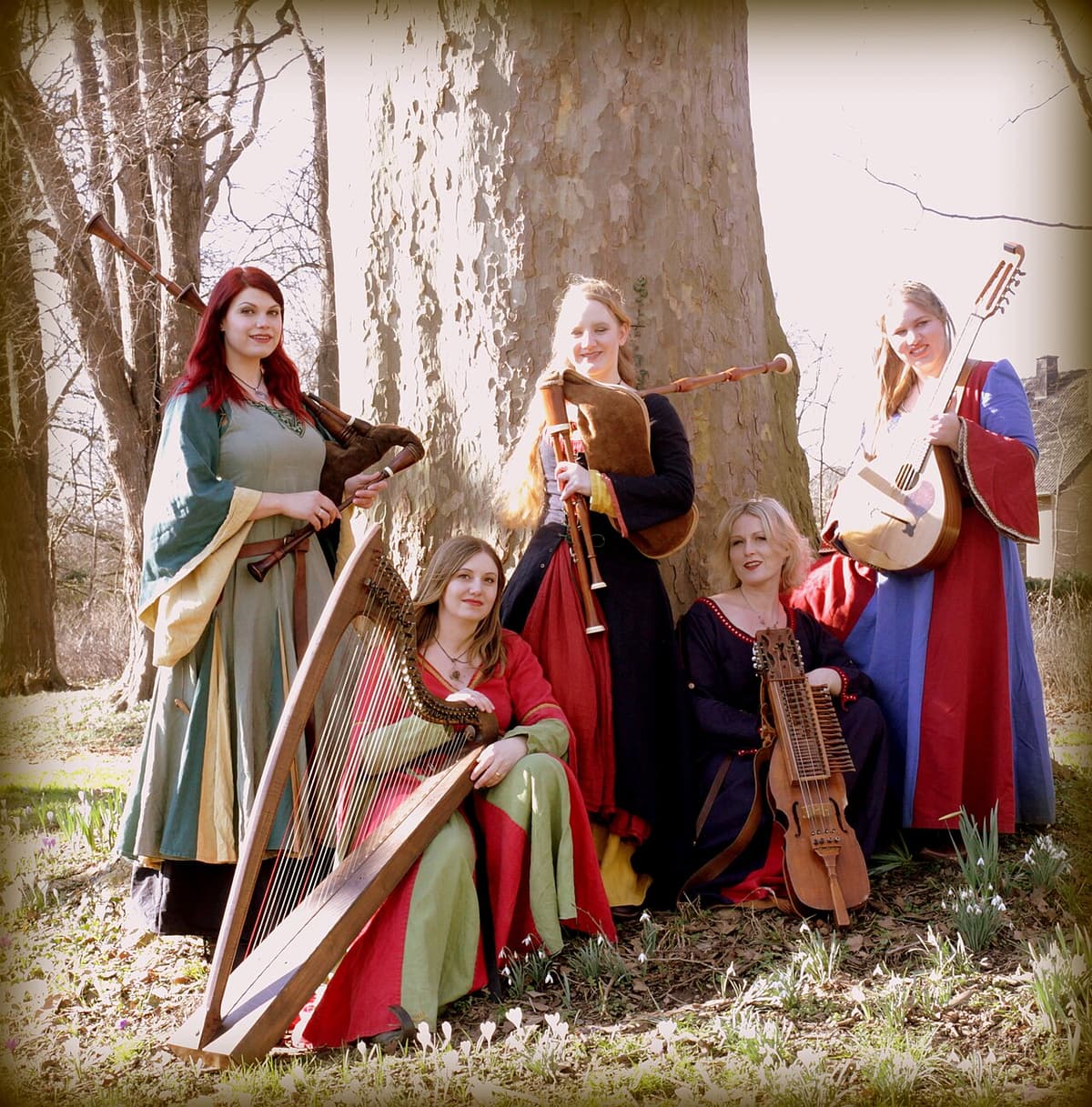
Die Irrlichter
Enchanting all-female medieval folk featuring harps, bagpipes, and intricate vocal harmonies. It is the sound of a forest clearing coming to life after dark.
Enchanting all-female medieval folk featuring harps, bagpipes, and intricate vocal harmonies. It is the sound of a forest clearing coming to life after dark.
Formed in 2001 in Germany, Die Irrlichter has evolved into one of the most prominent all-female ensembles in the European neo-medieval and folk scene. Their sound identity is rooted in the 'Mittelalterszene' (medieval scene), but they distinguish themselves through a focus on acoustic purity and historical instrumentation rather than the 'medieval rock' fusion common among their peers.
Their repertoire spans traditional European dances, reconstructed Renaissance pieces, and original compositions that mimic the structures of ancient folklore. The band underwent a significant transition in 2004 to an all-female lineup, which refined their vocal identity toward intricate polyphonic singing. Critically, they are respected for their technical proficiency on rare instruments like the nyckelharpa and chalumeau. Their career arc shows a progression from the upbeat, dance-oriented 'Koboldtanz' to more thematic, conceptually dense works like 'Rauhnächte', which focuses on the spiritual traditions of the winter solstice. They occupy a unique cultural niche, performing at both academic historical events and fantasy-themed festivals, serving as a gateway for listeners into the world of early music through a modern, accessible lens.
Shares neofolk, flute, chamber folk, soprano (subgenre)
Shares neofolk, chamber folk, winter, soprano (subgenre)
Shares baroque, neofolk, flute, acoustic folk (subgenre)
Shares harp, neofolk, flute, chamber folk (instrumentation)
Shares harp, flute, chamber folk, winter (instrumentation)
Shares baroque, harp, neofolk, flute (subgenre)
Shares harp, neofolk, flute, chamber folk (instrumentation)
Shares harp, neofolk, flute, chamber folk (instrumentation)
Shares neofolk, flute, winter, acoustic folk (subgenre)
Cassette uses generative AI to enrich its catalog. How we use AI →