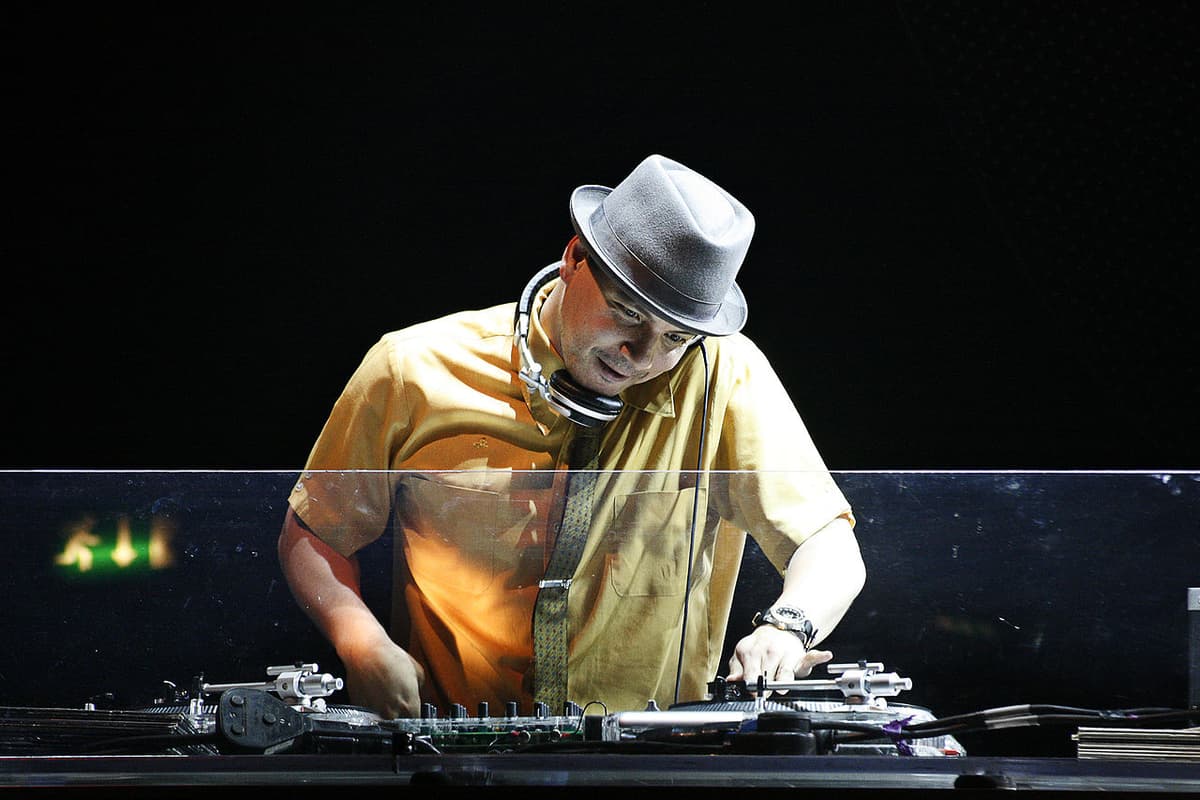
DJ QBert
Hyper-kinetic turntable wizardry that treats the crossfader like a surgical tool. Sci-fi soundscapes and jagged rhythms for deep focus or high-energy movement.
Hyper-kinetic turntable wizardry that treats the crossfader like a surgical tool. Sci-fi soundscapes and jagged rhythms for deep focus or high-energy movement.
DJ Qbert, born Richard Quitevis, is the definitive architect of modern turntablism. Emerging from the San Francisco hip-hop scene in the late 1980s, he transitioned the DJ from a time-keeper to a lead instrumentalist.
His tenure with the Invisibl Skratch Piklz and his dominant run in the DMC World Championships during the early 90s established a new technical vocabulary for the craft. Qbert is credited with inventing or refining many of the foundational scratch techniques used today, treating the turntable as a percussion and melodic device capable of complex improvisation. His sound identity is inextricably linked to a sci-fi, 'extraterrestrial' aesthetic, often utilizing B-movie samples and space-themed concepts. Critically, he is viewed as the 'Jimi Hendrix of the decks,' a figure who fundamentally altered the possibilities of his instrument. His influence extends beyond music into gaming and animation, most notably through the Wave Twisters project, which synchronized complex scratch compositions with surrealist visuals. He remains a central figure in the culture, bridging the gap between old-school b-boy foundations and avant-garde electronic experimentation.
Shares abstract hip-hop (subgenres); processed, spoken_word, absent (vocal style)
Shares playful, intense, mysterious (moods); sample_based, noise_textured, maximalist (production style)
Shares abstract hip-hop (subgenres); sample_based, noise_textured, lo_fi (production style)
Shares abstract hip-hop (subgenres); processed, absent (vocal style)
Shares sample_based, noise_textured, lo_fi (production style); abstract hip-hop (subgenres)
Shares abstract hip-hop (subgenres); playful, mysterious (moods)
Shares turntables, abstract hip-hop, sample_based, spoken_word (signature)
Cassette uses generative AI to enrich its catalog. How we use AI →