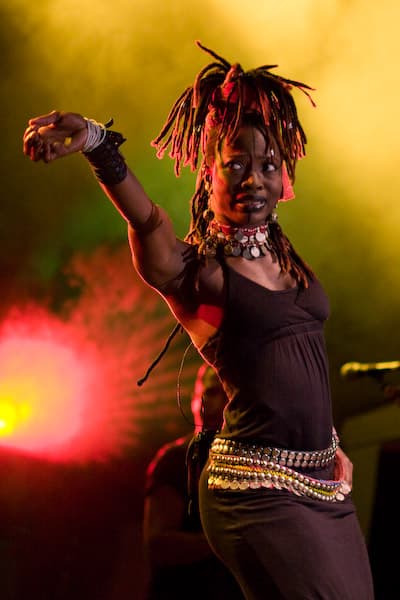
Dobet Gnahoré
Vibrant Ivorian rhythms meet modern pop polish. A high-energy celebration of Pan-African sounds led by powerful, multilingual vocals and intricate percussion.
Vibrant Ivorian rhythms meet modern pop polish. A high-energy celebration of Pan-African sounds led by powerful, multilingual vocals and intricate percussion.
Dobet Gnahoré creates music that feels like a physical manifestation of light. It is deeply rooted in the Bété traditions of the Ivory Coast, yet it refuses to stay in one place, traveling through Congolese rumba, Cameroonian bikoutsi, and modern electronic pop. The sound is defined by its percussive backbone: the woody resonance of the balafon and the sharp snap of the calebasse provide a rhythmic playground for her voice.
What truly sets her apart is her vocal versatility and her command of movement. She sings in over seven African languages, treating her voice as both a melodic lead and a rhythmic instrument. There is a sense of 'Ano Neko' (creating together) in every track, where the interplay between the acoustic guitar and the complex percussion creates a dense, joyous tapestry that feels both ancient and futuristic.
Start with the album 'Couleur' for a bright, modern introduction to her sound, or 'Djekpa La You' to hear the Grammy-winning depth of her songwriting. It is music for anyone who wants to feel capable, energized, and connected to a global pulse.
Dobet Gnahoré (born 17 June 1982) is a singer from Côte d'Ivoire. The daughter of percussionist Boni Gnahoré, she plays with the group Na Afriki, consisting mainly of French and Tunisian musicians, who accompany her with the guitar, sanza, the balafon, the calebasse and bongos. Due to the civil war, she moved to France in 1999. In 2004, Gnahoré released her debut album Ano Neko. In 2006, She was a nominee at the BBC Radio 3 Awards for World Music for Newcomer. In 2010, she shared an award for Best Urban/Alternative Performance with India.Arie at the 52nd Grammy Awards.
Cassette uses generative AI to enrich its catalog. How we use AI →


