Doof creates a sonic landscape that feels like a living, breathing organism made of electricity and ancient rhythm. The music is characterized by its relentless forward momentum, built on a foundation of driving 4/4 kicks and intricate, interlocking percussion that suggests a futuristic tribal gathering. Above this rhythmic engine, Nick Barber weaves a tapestry of squelchy 303 lines, shimmering pads, and alien sound effects that seem to rotate through the stereo field.
What truly sets Doof apart is the organic warmth of the production, a hallmark of the mid-90s London scene. Unlike the clinical precision of modern psytrance, this music has a tactile, liquid quality. The synthesizers don't just play notes; they growl, chirp, and dissolve into one another, creating a sense of constant transformation that mirrors a psychedelic experience. It is music that demands physical movement while simultaneously inviting deep mental exploration.
For those new to the sound, the 1996 album 'Let's Turn On' is the essential starting point. It captures the peak of the Goa trance movement, blending high-energy dancefloor anthems with moments of cosmic reflection. It is the sound of a specific moment in time when the boundaries between technology and spirituality were being blurred on dancefloors across the globe.
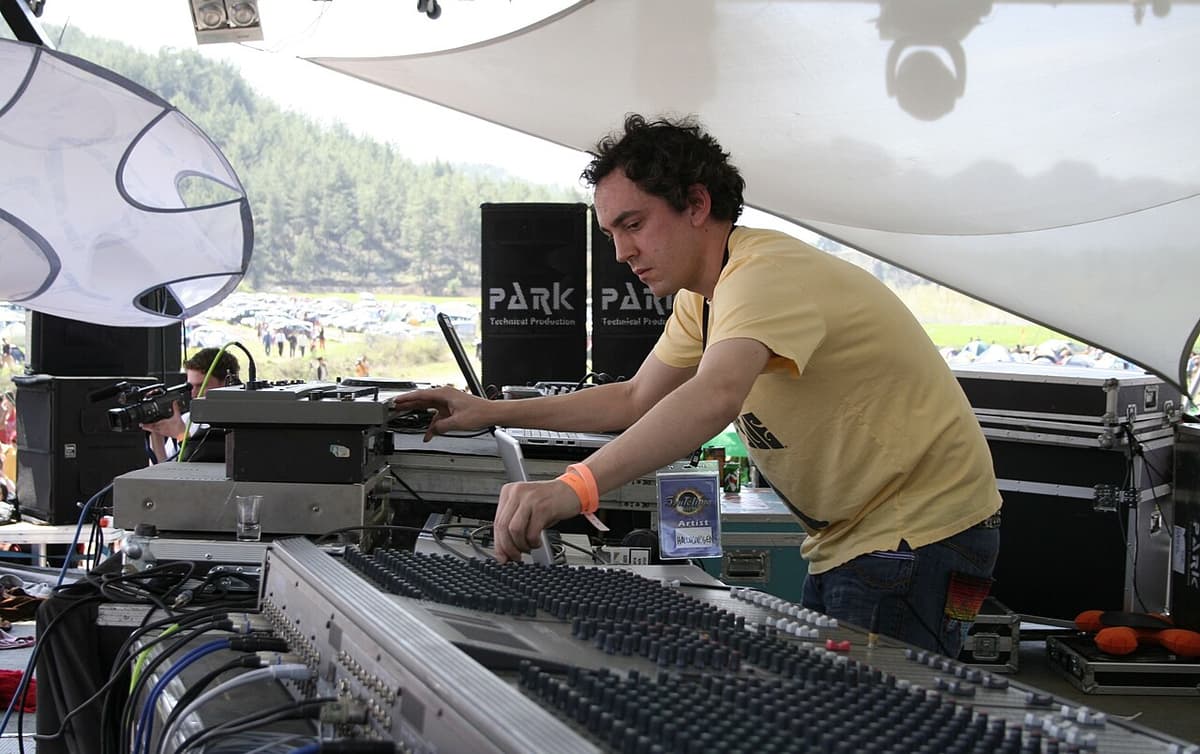
Nicholas Barber (born 31 August 1968), better known by the stage name Doof, is a British, London-based psychedelic trance musician. Doof's first official release was in 1993 with NovaMute, the dance label run by Mute Records, a three-track EP titled "Disposable Hymns to the Infinite". It was through Novamute label-mates Juno Reactor and Ben Watkins that Doof was first introduced to producer Youth (of Killing Joke/ Brilliant), Simon Posford, also known as Hallucinogen, and the Dragonfly Records label. Doof went on to release "Double Dragons" as a 12" with Dragonfly in 1994, and to produce a series of tracks in partnership with Simon Posford, including "Let's Turn On", "Born Again" and "Angelic Particles". It was through his friendship with Simon Posford that Doof was introduced to Raja Ram (Shpongle/The Infinity Project/Quintessence) who later that year would start the trance label T.I.P Records. Doof's "Let's Turn On" (co-produced with Simon Posford) became the second T.I.P 12" release. This was followed in 1995 by another 12" for T.I.P (Angelina/Weird Karma), the Born Again EP on Matsuri and another 12" for Dragonfly ("Youth of the Galaxy"). 1995 also saw numerous Doof remixes, including tracks by Hallucinogen and The Infinity Project. In 1996, the first Doof album Let's Turn On was released on T.I.P. Records, and went on to become one of the defining albums of the early psy-trance sound. It was subsequently re-released in 2000 by Twisted Records, who also released the second Doof album It's About Time the same year. During this time Doof travelled extensively performing live sets all over the globe including numerous appearances across Europe, in the U.S, South America and Japan. In 2001, he teamed up with friends Celli Firmi (Earthling/Soundaholix) and Mexican DJ and promoter Xavier Fux (Zulu Lounge) to collaborate on the psy-house project Vatos Locos. The first Vatos Locos album (Welcome to the Barrio) was released later that year by Sony Music. The second album, Attack and Release, went out in 2004 with Dragonfly Records. It was around this time that Doof began to grow disillusioned with the commercial and musical direction that the psy-trance scene was taking, and started to explore other avenues of musical expression. He is also one half of downtempo electronica project Third Ear Audio with Celli Firmi, and as a singer/songwriter is recording acoustic songs as Nick Barber. In 2008, he released an acoustic album called Clear Blue Sky under his own name. This was followed by a second album of songs called Seeds. In April 2015, Let's Turn On was re-released by DAT Records in a remastered and expanded double CD version, featuring vintage alternate mixes of all the original tracks. One reviewer nominated it "the greatest Goa trance album of all time". In early 2015, he started work as composer for the soundtrack of Bruce Parry's forthcoming documentary Quest. The film was eventually released under the title Tawai, A Voice from the Forest in September 2017. The original soundtrack album with music by Barber was also released at the same time.


Shares analog warmth, layered dense, reverb heavy (production style); festival, midnight, desert (atmosphere)
Shares analog warmth, layered dense, reverb heavy (production style); mysterious, energetic (moods)
Shares analog warmth, layered dense, reverb heavy (production style); festival, midnight, desert (atmosphere)
Shares euphoric, mysterious, energetic (moods); analog warmth, layered dense, reverb heavy (production style)
Shares analog warmth, layered dense, reverb heavy (production style); festival, midnight, desert (atmosphere)
Shares analog warmth, layered dense, reverb heavy (production style); processed, chanting, spoken word (vocal style)
Shares festival, midnight, desert (atmosphere); euphoric, mysterious, energetic (moods)
Shares analog warmth, layered dense, reverb heavy (production style); processed, spoken word, absent (vocal style)
Shares euphoric, mysterious, energetic (moods); processed, spoken word, absent (vocal style)
Shares festival, desert, stargazing (atmosphere); mysterious, energetic (moods)
Shares desert, liquid, modular synth, forest (atmosphere)
Cassette uses generative AI to enrich its catalog. How we use AI →