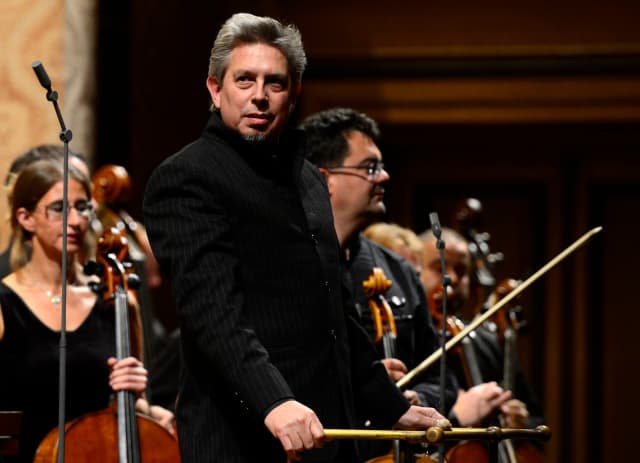
Elliot Goldenthal
High-drama orchestral landscapes where microtonal brass meets gothic elegance. Intense, intellectual, and deeply cinematic music for focused, dark-room immersion.
High-drama orchestral landscapes where microtonal brass meets gothic elegance. Intense, intellectual, and deeply cinematic music for focused, dark-room immersion.
Elliot Goldenthal creates music that feels like a massive, ornate cathedral constructed from both marble and industrial steel. His sound is defined by a staggering sense of scale, often utilizing huge orchestral forces to create textures that are simultaneously beautiful and terrifying. You will hear shimmering, ethereal strings suddenly interrupted by violent, dissonant brass clusters or heavy, ritualistic percussion. It is music that demands your full attention, rewarding the listener with complex emotional payoffs.
What truly sets him apart is his 'circus-macabre' sensibility and his willingness to break the rules of traditional film scoring. He frequently incorporates non-classical elements like distorted electric guitars, saxophones, and synthesizers into a rigorous symphonic framework. His work with microtonality, where notes are played between the standard keys of a piano, creates a unique sense of unease and psychological depth that few other composers can replicate.
For those new to his world, the score for Interview with the Vampire is the perfect entry point, offering a lush, melancholic take on gothic romance. If you want to hear his more aggressive, experimental side, Alien 3 provides a masterclass in tension and avant-garde orchestral dread. For something vibrant and culturally rich, his Oscar-winning Frida showcases his ability to blend traditional Mexican folk influences with his own sophisticated harmonic language.
Elliot Goldenthal (born May 2, 1954) is an American composer of contemporary classical music and film and theatrical scores. A student of Aaron Copland and John Corigliano, he is best known for his distinctive style and ability to blend various musical styles and techniques in original and inventive ways. He won the Academy Award for Best Original Score in 2002 for his score to the motion picture Frida, directed by his longtime partner Julie Taymor.
Cassette uses generative AI to enrich its catalog. How we use AI →


