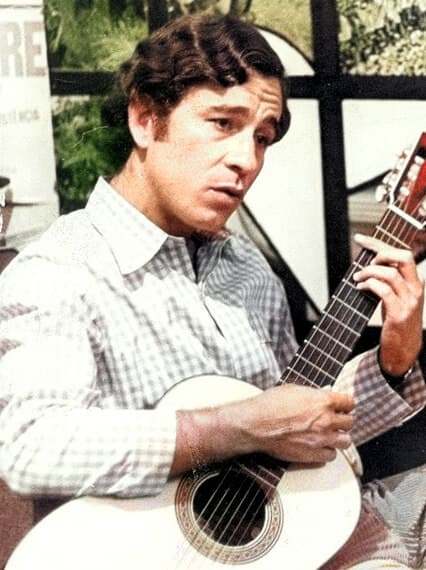
Geraldo Vandré
Stark, anthemic Brazilian folk that fueled a generation of resistance. Powerful baritone vocals over rhythmic acoustic guitars and rural textures.
Stark, anthemic Brazilian folk that fueled a generation of resistance. Powerful baritone vocals over rhythmic acoustic guitars and rural textures.
Geraldo Vandré sounds like the conscience of a nation captured in a single, resonant baritone. His music is defined by a striking clarity, often stripping away the lushness of bossa nova in favor of the raw, rhythmic urgency of the Brazilian Northeast. It is music that feels grounded in the earth, using the acoustic guitar and the viola caipira to create a sense of inevitable momentum. There is a weight to every note, a feeling that the songs were forged in moments of high stakes and deep conviction.
What makes Vandré distinctive is his ability to transform simple folk structures into massive, collective anthems. Unlike his contemporaries who often favored metaphorical complexity, Vandré’s most famous work possesses a directness that is both beautiful and intimidating. He utilizes a specific 'maracatu' and 'baião' rhythmic pulse that gives his protest music a marching, unstoppable quality. His voice doesn't just sing; it commands, leading the listener through narratives of struggle and hope with a liturgical solemnity.
Start with 'Canto Geral' to hear the peak of his creative and political powers. It captures the tension of 1960s Brazil perfectly, blending sophisticated arrangements with the grit of rural folk. For those seeking the quintessential protest anthem, 'Pra não dizer que não falei das flores' remains one of the most significant recordings in Latin American history, a masterclass in how a simple melody can challenge an entire regime.
Geraldo Vandré (born Geraldo Pedrosa de Araujo Dias, September 12, 1935) is a Brazilian singer, composer and guitar player. In 1966, his song Disparada ("Gone Off"), interpreted by Jair Rodrigues, was a success at the Record Festival. The song rose to number one, tied with Chico Buarque's "A banda". Later in 1966, the group Quarteto Novo was created to accompany him in concert and on recordings and released a landmark album in 1967. In 1968, Vandre entered his song "Pra não dizer que não falei de flores", also known as "Caminhando" ("Walking"), in the third Festival Internacional da Canção. The song had the following refrain: This was thought to be a call to fight the dictatorship in charge. The song lost to "Sabiá" by Chico Buarque and Tom Jobim. Also in 1968, still with the AI-5, Vandré had to go into exile. The first artist ever to sing "Caminhando" after censorship's lift was Simone in 1979, reaching enormous success from both public and critics. First he stayed at the farm of the late Guimarães Rosa, who had died the previous year, then he proceeded to Chile, and finally to France. Since returning to Brazil in 1973, Vandré has been living and composing in São Paulo. He discounts rumors that he has been tortured, or that he was an anti-militarist, saying that this image was fabricated. One of his recent songs has been "Fabiana", written in honor of the Brazilian Air Force (Força Aérea Brasileira – FAB) and presented at the São Paulo Municipal Library some time in the 1990s.
Cassette uses generative AI to enrich its catalog. How we use AI →


