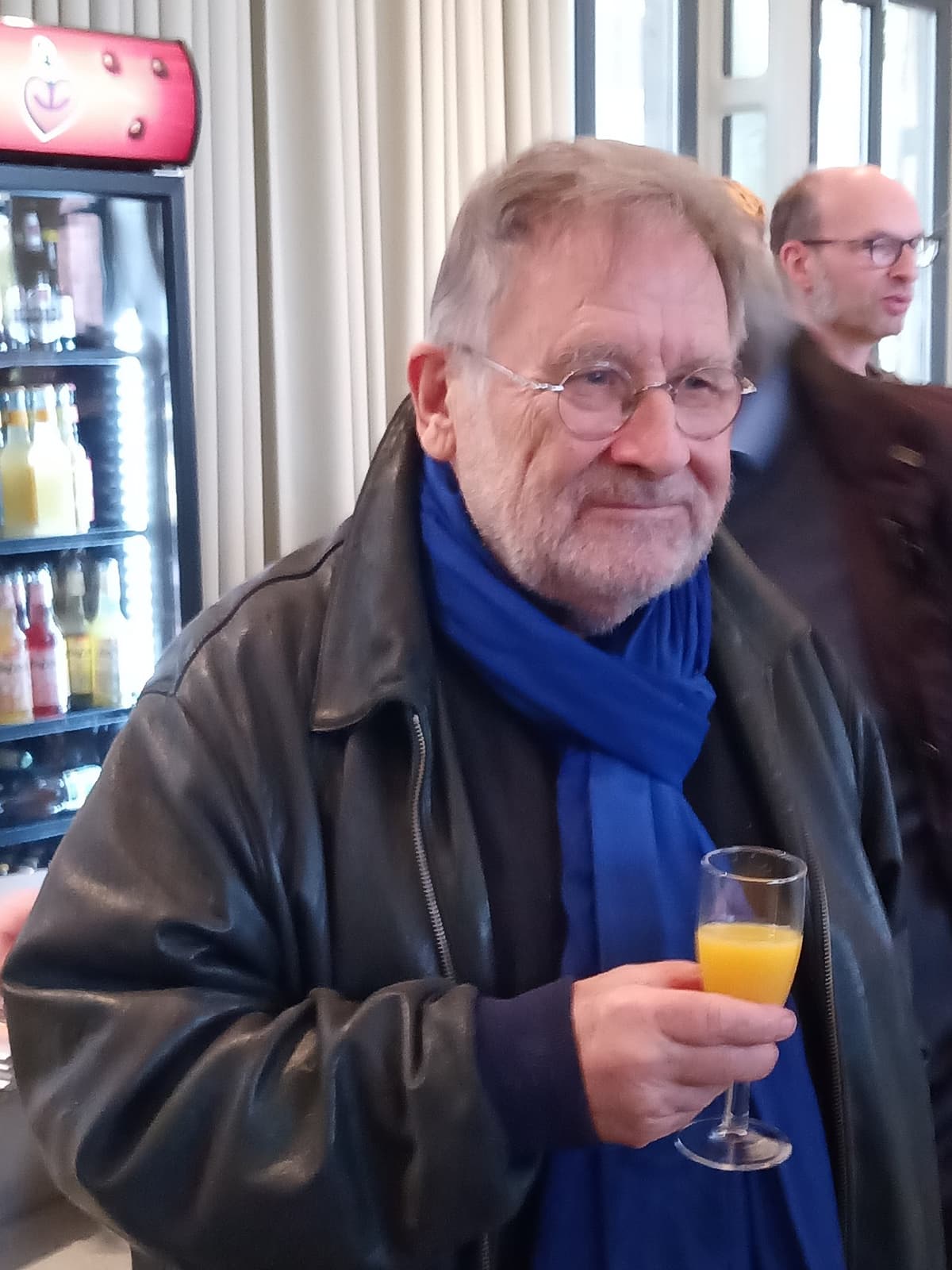
Irmin Schmidt
Atmospheric keyboard landscapes and cinematic pulses from Can's founding visionary. Intellectual, moody, and deeply evocative music for deep focus or late nights.
Atmospheric keyboard landscapes and cinematic pulses from Can's founding visionary. Intellectual, moody, and deeply evocative music for deep focus or late nights.
Irmin Schmidt's music feels like a walk through a European city at 3 AM. It is deeply intellectual but never cold, carrying the warmth of analog synthesizers and the precision of a classical conductor. You can hear the ghosts of his training under Stockhausen and Ligeti, but they are filtered through the rhythmic, experimental spirit of the Krautrock movement he helped define.
What makes him distinctive is his ability to blend high-art avant-garde techniques with a cinematic sensibility. His solo work, particularly his extensive soundtrack catalog, strips away the motorik drive of his former band to reveal a more skeletal, haunting beauty. It is music that prioritizes space and texture over traditional melody, creating a sense of unfolding narrative without the need for words.
For those new to his solo output, the Anthology: Soundtracks collection is the essential entry point. It showcases his range from tense, noirish electronics to lush, melancholic piano pieces. It's the perfect companion for anyone who loves the atmospheric side of David Bowie's Berlin era or the more experimental edges of modern film scoring.
Irmin Schmidt (born 29 May 1937) is a German keyboardist and composer, best known as a founding member of the Krautrock band Can and composer of numerous film scores. Following the death of Can's second lead vocalist Damo Suzuki in February 2024, Schmidt is one of two surviving former members of the band, alongside original vocalist Malcolm Mooney. Before joining Can, Schmidt studied composition with composers as György Ligeti, Karlheinz Stockhausen, Luciano Berio, Henri Pousseur, Earle Brown, and István Kertész. He started work mainly as a conductor performing concerts with the Bochum Symphony, the Vienna Symphony, and the Dortmund Ensemble for New Music. During this time, Schmidt conducted the West German premiere of John Cage's "Atlas Eclipticalis" with Bochum Symphony Orchestra and performed Cage's piano piece "Winter Music". By 1966 Schmidt got a position as Kapellmeister at the Theater Aachen, hired as docent for musical theatre and chanson, and worked at the Schauspielschule Bochum (drama school) teaching vocal technique. Since early 1980s, Schmidt produced soundtrack compositions for such TV and films as Knife in the Head (1978) and Palermo Shooting (2008). Additionally, he has recorded solo albums and written an opera, Gormenghast, based on Mervyn Peake's Gormenghast Trilogy. He received the Ordre des Arts et des Lettres (Chevalier) in 2015 and Order of Merit of the Federal Republic of Germany in 2025.
Cassette uses generative AI to enrich its catalog. How we use AI →


