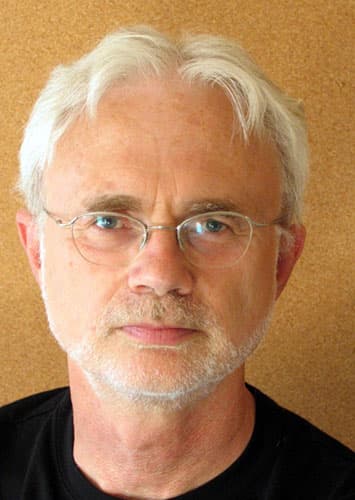
John Adams
Pulsing, high-octane orchestral music that feels like a city in motion. Modern minimalism with the emotional weight of a grand romantic symphony.
Pulsing, high-octane orchestral music that feels like a city in motion. Modern minimalism with the emotional weight of a grand romantic symphony.
John Adams creates music that feels like the heartbeat of the modern world. It is built on the repetitive, pulsing foundations of minimalism, but it breathes with the scale and emotional depth of 19th-century Romanticism. You will hear shimmering string textures, bright brass fanfares, and woodwind patterns that interlock like the gears of a precision watch. It is music that captures the frantic energy of a metropolis while maintaining a sense of profound, often spiritual, contemplation.
What sets Adams apart is his ability to ground abstract musical patterns in human history. His operas and orchestral works often tackle massive, real-world subjects: the birth of the atomic bomb, presidential diplomacy, or urban decay. This gives his work a narrative urgency that many of his minimalist peers lack. The sound is often 'maximalist' in its impact, using the full power of a symphony orchestra to create massive crescendos and complex, driving rhythms that demand your full attention.
For those new to his sound, the best place to start is with his shorter orchestral works like 'Short Ride in a Fast Machine' to feel the rhythmic drive, or 'Harmonielehre' for a deeper, more symphonic experience. If you enjoy the intersection of politics and art, his opera 'Nixon in China' is an essential masterpiece of modern storytelling.
John Coolidge Adams (born February 15, 1947) is an American composer and conductor. Among the most regularly performed composers of contemporary classical music, he is particularly noted for his operas, many of which center around historical events. Apart from opera, his oeuvre includes orchestral, concertante, vocal, choral, chamber, electroacoustic, and piano music. Born in Worcester, Massachusetts, Adams grew up in a musical family and was exposed to classical music, jazz, musical theatre, and rock music. He attended Harvard University, studying with Leon Kirchner, Roger Sessions, and David Del Tredici, among others. His earliest work was aligned with modernist music, but he began to disagree with its tenets upon reading John Cage's Silence: Lectures and Writings. Teaching at the San Francisco Conservatory of Music, Adams developed a minimalist aesthetic first fully realized in Phrygian Gates (1977) and later in the string septet Shaker Loops. Adams became increasingly active in San Francisco's contemporary music scene, and his orchestral works Harmonium (1980–1981) and Harmonielehre (1985) first gained him national attention. Other popular works from this time include the fanfare Short Ride in a Fast Machine (1986) and the orchestral work El Dorado (1991). Adams's first opera was Nixon in China (1987), which recounts Richard Nixon's 1972 visit to China and was the first of many collaborations with theatre director Peter Sellars. Though the work's reception was initially mixed, it has become increasingly respected since its premiere, receiving performances worldwide. Begun soon after Nixon in China, the opera The Death of Klinghoffer (1991) was based on the Palestinian Liberation Front's 1985 hijacking and murder of Leon Klinghoffer and incited considerable controversy for its subject matter. His next notable works include a Chamber Symphony (1992), a Violin Concerto (1993), the opera-oratorio El Niño (2000), the orchestral piece My Father Knew Charles Ives (2003), and the six-string electric violin concerto The Dharma at Big Sur (2003). Adams won a Pulitzer Prize for Music for On the Transmigration of Souls (2002), a piece for orchestra and chorus commemorating the victims of the September 11, 2001 attacks. Continuing with historical subjects, Adams wrote the opera Doctor Atomic (2005), based on J. Robert Oppenheimer, the Manhattan Project, and the building of the first atomic bomb. Later operas include A Flowering Tree (2006), Girls of the Golden West (2017), and Antony and Cleopatra (2022). In many ways, Adams's music is developed from the minimalist tradition of Steve Reich and Philip Glass, but he tends to more readily engage in the immense orchestral textures and climaxes of late Romanticism in the vein of Wagner and Mahler. His style is to a considerable extent a reaction against the modernism and serialism of the Second Viennese and Darmstadt Schools. In addition to the Pulitzer, Adams has received the Erasmus Prize, a Grawemeyer Award, five Grammy Awards, the Harvard Arts Medal, France's Ordre des Arts et des Lettres, and six honorary doctorates.
Cassette uses generative AI to enrich its catalog. How we use AI →


