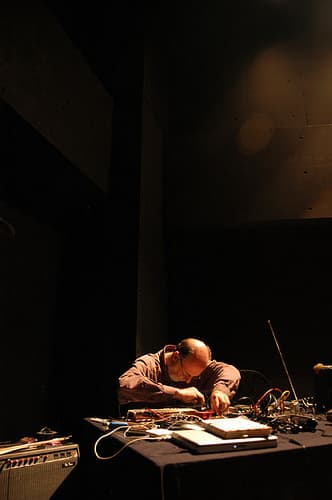
Keith Rowe
Static, crackling textures and shortwave radio ghosts. Tabletop guitar played like a canvas, creating a space for deep, patient observation of sound.
Static, crackling textures and shortwave radio ghosts. Tabletop guitar played like a canvas, creating a space for deep, patient observation of sound.
Keith Rowe is the foundational figure of Electroacoustic Improvisation (EAI), a movement that bridged the gap between free jazz and contemporary electronic music. Emerging from the 1960s British experimental scene as a founding member of the collective AMM, Rowe famously abandoned conventional guitar technique by laying the instrument flat on a table and manipulating it with found objects.
This 'tabletop' approach effectively neutralized the guitar's history, allowing him to treat it as a sound generator rather than a harmonic tool. His work is deeply influenced by the visual arts, particularly the concepts of Jackson Pollock and Marcel Duchamp, applying the logic of abstract expressionism to sound. Over a career spanning six decades, he has collaborated with nearly every major figure in the avant-garde, including John Tilbury and Christian Fennesz, and remains a central figure for the Erstwhile Records aesthetic. His influence is seen in the works of noise artists, sound designers, and minimalists who prioritize texture and silence over melody.
Cassette uses generative AI to enrich its catalog. How we use AI →


