Les Poppys
Pure, soaring boy-choir vocals meet 1970s French pop production. Earnest anti-war anthems that feel like a sun-drenched time capsule of hippie-era idealism.
Pure, soaring boy-choir vocals meet 1970s French pop production. Earnest anti-war anthems that feel like a sun-drenched time capsule of hippie-era idealism.
Les Poppys offer a singular experience in the history of French pop, blending the disciplined purity of a traditional boys' choir with the groovy, technicolor production of the early 1970s. Their sound is defined by high-register unison singing and soaring solos that carry a surprising weight of social consciousness. It is music that feels both fragile and immensely powerful, capturing a specific moment when youth culture and traditional choral music collided.
What truly distinguishes them is the contrast between their innocent delivery and their heavy lyrical themes. While their contemporaries were singing about romance, Les Poppys were tackling the Vietnam War and the failures of the adult world. This juxtaposition creates a bittersweet tension; the music is catchy and bright, but the underlying message is a plea for a better world, delivered with the unvarnished sincerity that only children can provide.
Start with 'Non, non, rien n'a changé' to hear their definitive sound. It is a masterpiece of 70s chanson, featuring a driving rhythm section and a melody that stays with you for days. From there, explore 'Noël 70' to understand how they transformed traditional holiday sentiments into a poignant social statement that resonated across Europe.
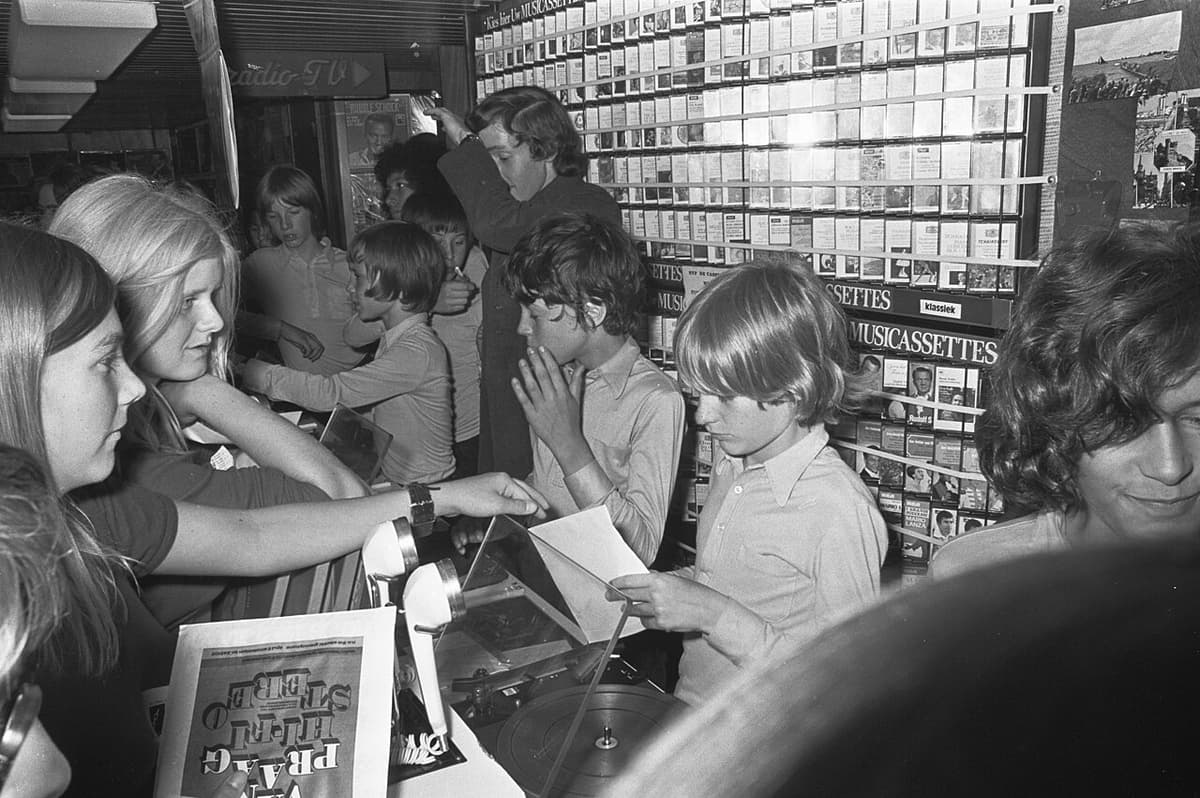
Les Poppys is a French musical group of 17 children founded 1946 in Asnières, France by Jean Amoureux as Les Petits Chanteurs d'Asnières and renamed to Les Poppys in 1970. Francois Bernheim, former singer of the group Les Roche-Martin and artistic director for the record company Barclay, discovered the singers in 1970 and decided to create a group called Les Poppys, named after the word 'Pop Music'. Les Poppys originated from the Hippie movement and made songs against the Vietnam War. Seventeen boys from the choir were then selected and recorded their first single: 'Noel 70'. The success came very quickly and 600,000 copies were sold. This first single was then followed by other hits during the 70's: 'Isabelle, je t'aime' (500,000 copies sold). The most successful chanson was Non, non, rien n'a changé, for which Bruno Polius was the lead solo singer, and which sold 1,200,000 copies and was a number one hit in The Netherlands and stayed in the Dutch Top 40 for 25 weeks. Les Poppys became the first child stars in French music history and were quickly invited by other countries to sing in galas, concerts and TV shows. In The Netherlands and in Germany, they even sold more records than the Beatles. In 4 years, Les Poppys sold more than 5 million records and produced four albums and 20 singles from 1970 to 1977. Their success inspired the New Poppys and other groups such as Mercredi Libre from members of Les Petits Chanteurs D'Asnières. The small singers of Asnières, as they were, consisted of the first generation of Poppys: Bruno Polius, Harry Trowbridge, Philippe and Gabriel Képéklian, Thierry and Philippe Sellier, Philippe and Jean-Pierre Herman, Philippe Magnan, Jean-Jacques Gallard, Pascal Buffenoir, Pierre Puyhardy, Olivier Dubrez, Benoit Cabane, Christophe Normand, Bernard Carayon, Olivier Antignac. Some among them left since 1971 to yield to the second generation of Poppys which included Gérald Meunier, Pascal Oubrayrie, Alain Drexler, Pascal Réali and Daniel Danglard. The group ended in 1978 but Les Petits Chanteurs d'Asnières kept on recording, making backgrounds vocals for famous singers. They also sang in 1983 for a TV musical covering songs by ABBA called Abbacadabra. Their 2 albums made were called: Abbacadabra and La Fusée de Noé. They also had a one off success with the song "Il faudra leur dire" sung with Francis Cabrel which went gold in 1987. They have since tried a comeback firstly in the late eighties under the name The New Poppys and in 1992 as Mercredi Libre. Although these last recordings were not commercially successful the album La ballade des p'tits anges has become highly praised and sought after. Although it has been suggested that the singing is better on this CD it is most likely due to the new songs included on this CD. The music to Commandant de la Calypso, La ballade des p'tits anges, Je te demande pas and other popular songs from this album was written by Francois Bernheim. The Poppys still go on tour occasionally.
Shares traditional pop, baroque pop, psychedelic rock (subgenres); orchestral arrangement, analog warmth, studio polished (production style)
Shares traditional pop, baroque pop (subgenres); orchestral arrangement, analog warmth, studio polished (production style)
Shares orchestral arrangement, analog warmth, studio polished (production style); traditional pop, baroque pop (subgenres)
Shares traditional pop, baroque pop (subgenres); orchestral arrangement, analog warmth, studio polished (production style)
Shares traditional pop, baroque pop (subgenres); studio polished, orchestral arrangement, analog warmth (production style)
Shares traditional pop, baroque pop, psychedelic rock (subgenres); orchestral arrangement, analog warmth, studio polished (production style)

Shares traditional pop, baroque pop (subgenres); orchestral arrangement, analog warmth, studio polished (production style)
Shares orchestral arrangement, analog warmth, studio polished (production style); traditional pop, baroque pop (subgenres)
Shares traditional pop, baroque pop, psychedelic rock (subgenres); studio polished, orchestral arrangement, analog warmth (production style)
Shares orchestral arrangement, analog warmth, studio polished (production style); baroque pop, psychedelic rock (subgenres)
Shares baroque pop, wall of sound, traditional pop, psychedelic rock (subgenre)
Cassette uses generative AI to enrich its catalog. How we use AI →


