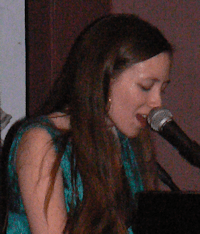
Liz Green creates a sound that feels unearthed rather than recorded. It is a world of dusty floorboards, velvet curtains, and the flickering light of a dying candle. Her music occupies a strange, beautiful intersection between the grit of pre-war blues, the whimsy of English folk, and the dramatic flair of a Weimar-era cabaret. There is an unmistakable weight to the arrangements, often anchored by a stately, slightly out-of-tune piano and punctuated by mournful brass.
What truly sets her apart is her voice: a distinctive, elastic instrument that can shift from a conspiratorial whisper to a soulful, raspy croon. She sings like a narrator in a surrealist play, delivering lyrics that are rich with imagery, dark humor, and existential curiosity. The production favors analog warmth and space, allowing the natural creaks of the instruments and the breath in her delivery to become part of the composition itself.
Start with her debut album 'O, Devotion!' to experience her at her most evocative. It is a collection of songs that feel like short stories, perfect for those moments when you want to disappear into a different time or a more contemplative state of mind. It is music for the quiet hours, rewarding those who listen with full attention.
Liz Green is an English, Manchester-based, singer-songwriter. In 2007, Green won the Glastonbury Festival Emerging Talent competition. In 2011 she released her debut album, O, Devotion!. In 2012 she recorded a cover of Leonard Cohen's "Sisters of Mercy" for a covers compilation; it was later offered as a download from her website. Her second album Haul Away! was released in 2014. Later that year, she played a radio session on Marc Riley's BBC 6 Music evening show, featuring a cover of David Bowie's "Five Years". Other than a self-distributed 2017 EP, Crow Cries, Green has released no music since.







Cassette uses generative AI to enrich its catalog. How we use AI →