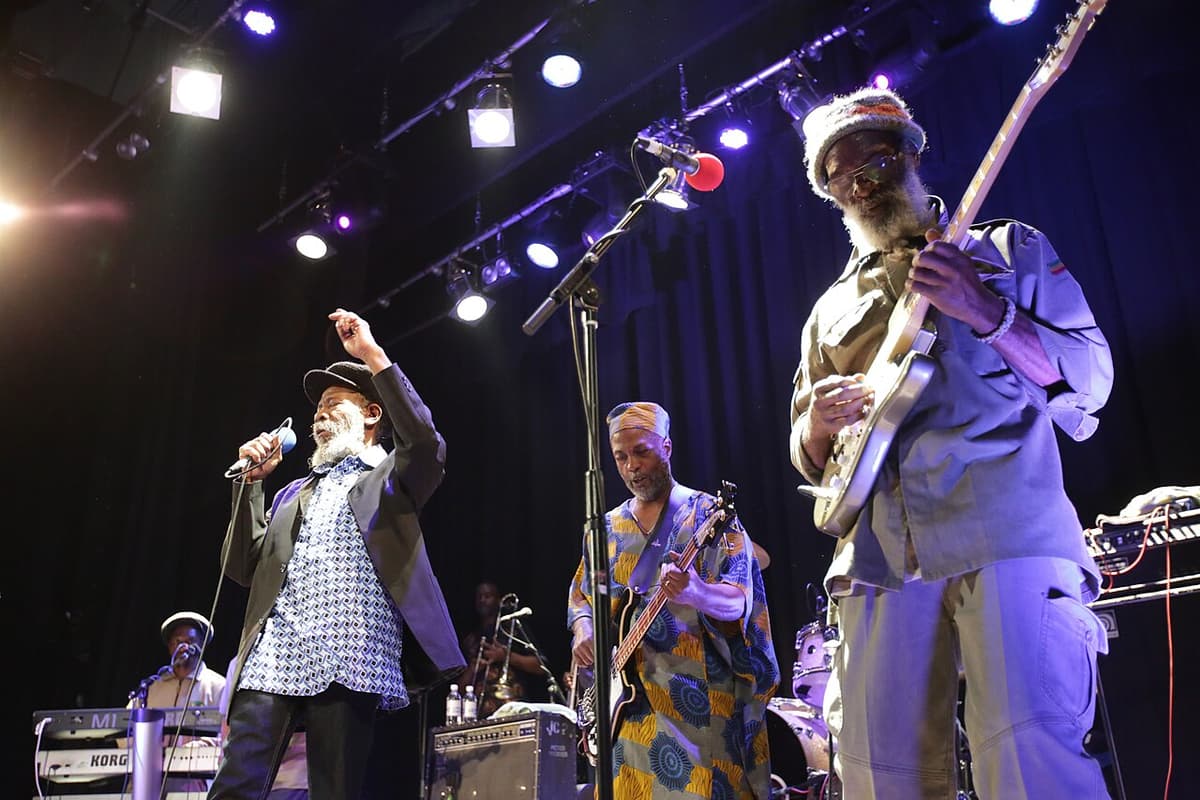
Misty in Roots
Raw, politically charged roots reggae with a heavy live energy. Deep basslines and spiritual harmonies that feel like a call to action in a crowded basement.
Raw, politically charged roots reggae with a heavy live energy. Deep basslines and spiritual harmonies that feel like a call to action in a crowded basement.
Misty in Roots offers a sound that is both grounded and transcendent. Unlike the polished studio sheen of many of their contemporaries, their music carries the grit and immediacy of the live stage. It is roots reggae in its most orthodox and honest form, built on massive, unwavering basslines and a rhythmic pocket that feels like it could sustain the world. There is a specific warmth to their recordings that feels like being in the room with them, capturing the air and the collective spirit of the band.
What truly distinguishes them is the marriage of deep Rastafarian spirituality with fierce, anti-fascist political conviction. This isn't just music for relaxation; it is music for reflection and resistance. The vocal harmonies are layered and communal, lacking the ego of a single frontman and instead favoring a collective voice that feels ancient and urgent all at once. The production is sparse but heavy, allowing the natural timbre of the instruments to breathe.
Start with 'Live at the Counter Eurovision 79'. It is widely considered one of the greatest live reggae albums ever recorded, perfectly capturing the band's power and the specific cultural tension of late-70s London. From there, move to 'Earth' for a more focused studio exploration of their spiritual themes.
Misty in Roots are a British roots reggae band formed in Southall, London, in the mid 1970s. Their first album was 1979's Live at the Counter Eurovision, a record full of Rastafarian songs. The Counter Eurovision, held in Brussels, was organised as an alternative to the cheesy and conservative pop of the established Eurovision proper – a 'bread and circuses’ extravaganza in the eyes of many on the left. The album was championed by BBC Radio 1 DJ John Peel, helping to bring roots reggae to a white audience. At this early stage, the band was a collective with five lead singers and various musicians, though by the time of the second album proper the band had slimmed down to just three members. Along with Steel Pulse, Aswad, Matumbi, Cimarons and Black Slate, Misty in Roots were one of the most popular British reggae bands of the late 1970s. Following their debut, Misty in Roots released four studio albums through the 1980s. The band had two BBC Radio 1 "In Concert" appearances in 1983 and 1985. They were invited to play in Zimbabwe in 1982 in recognition of their support for the independence movement, and were the first reggae band to tour South Africa, Poland, and Russia. After a break from recording in the next decade the band returned with a new mini-album Roots Controller in 2002. and continue to play concerts as of 2014. Misty in Roots supported Rock Against Racism, playing several gigs to raise money for anti-fascist causes. In 1979 Clarence Baker, a member of the collective, was beaten in the head by a member of the London Metropolitan Police during a protest in Southall against a National Front meeting, and fell into a coma. The punk band The Ruts, who were partners of the same collective, and had their debut single released by the People Unite co-operative, honoured him in their song "Jah War" which was released as a single and on their album The Crack the same year.
Cassette uses generative AI to enrich its catalog. How we use AI →


