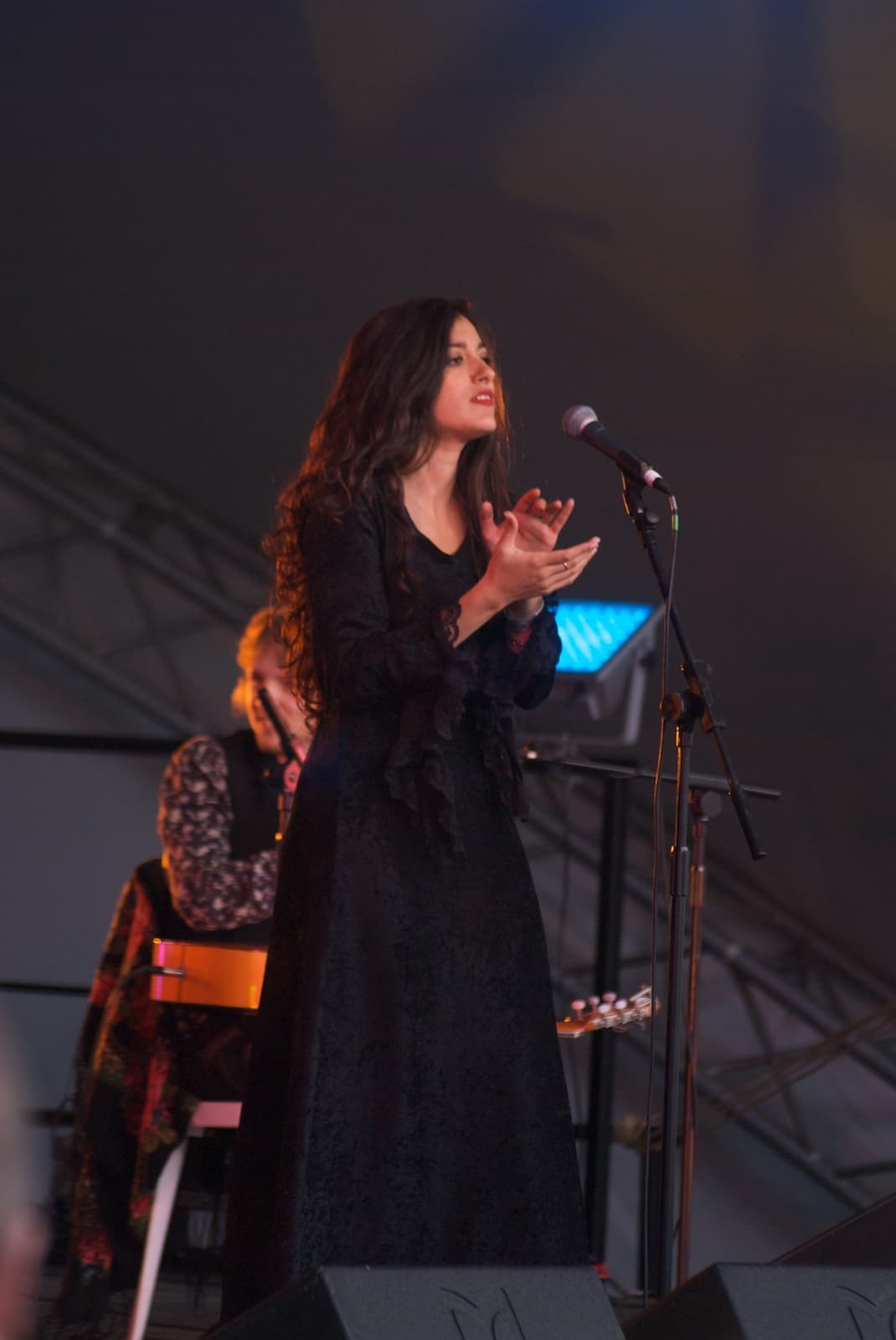
Mor Karbasi
Haunting Sephardic melodies meet the fire of flamenco. A breathtaking, operatic journey through the ancient Ladino language and Mediterranean history.
Haunting Sephardic melodies meet the fire of flamenco. A breathtaking, operatic journey through the ancient Ladino language and Mediterranean history.
Mor Karbasi possesses a voice that feels like it has traveled through centuries to reach the present. It is a sound rooted in the Sephardic tradition, specifically the Ladino language, but it is far from a museum piece. Her music is vibrant, dramatic, and deeply physical, drawing heavily on the rhythmic intensity and emotional vulnerability of flamenco. The arrangements often balance the intimacy of an acoustic guitar with the sweeping grandeur of chamber strings, creating a space that feels both ancient and cinematic.
What sets Karbasi apart is her ability to bridge the gap between the sacred and the secular. She takes Piyyutim, liturgical poems traditionally reserved for male voices, and reclaims them with a powerful, feminine energy. Her Moroccan and Persian heritage informs the melodic scales, giving the music a distinct Maghreb flavor that distinguishes it from more standard European folk. The result is a sonic tapestry where every vocal trill and guitar flourish feels intentional and heavy with history.
Start with 'The Beauty and the Sea' to hear the full scope of her ambition. It is an album that showcases her ability to move from a whisper to a roar, perfectly capturing the 'diva' energy that critics have praised. It is essential listening for anyone who loves the intersection of folk tradition and high-drama vocal performance.
Mor Karbasi (Hebrew: מור קרבסי; born April 23, 1986) is an Israeli singer-songwriter born in Jerusalem and now based in Seville after five years in London. One of her main projects is Ladino music, also known as Judezmo, Spanyolit, or Sephardic—the ancient language and music of the exiled Jews of Portugal and Spain. She writes original material, as well as singing traditional songs. She has been compared to Mariza and Yasmin Levy, but has a strongly individual sound, whichever type of music she sings. Karbasi's heritage is mixed Iranian (paternal) and Moroccan (maternal), and according to her Moroccan Jewish grandfather, "the blood remembers," meaning that before this her ancestors came from Spain. Her connection to this culture is expressed passionately through her music. Her family name Karbasi means "canvas" in Persian.
Cassette uses generative AI to enrich its catalog. How we use AI →

