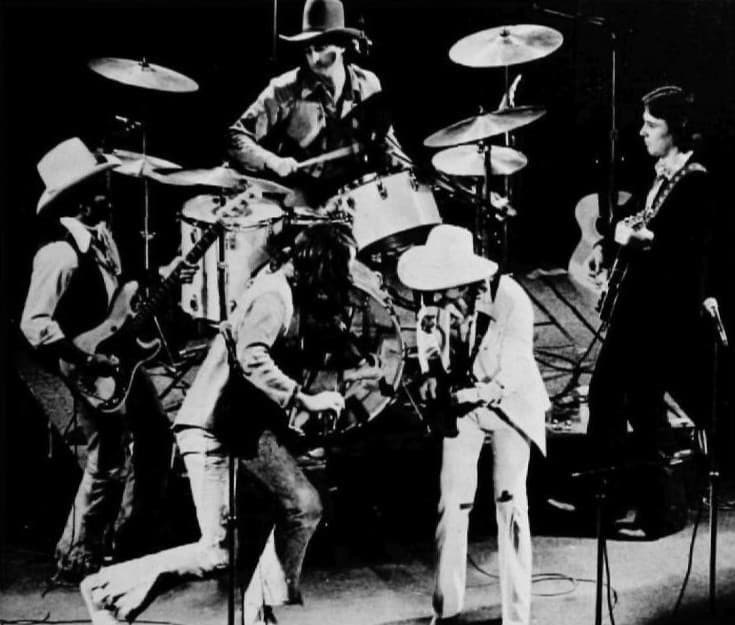
Nitty Gritty Dirt Band
Authentic, harmony-drenched country rock that bridges the gap between hippie idealism and Nashville tradition. Warm, acoustic-driven storytelling for open roads.
Authentic, harmony-drenched country rock that bridges the gap between hippie idealism and Nashville tradition. Warm, acoustic-driven storytelling for open roads.
Listening to the Nitty Gritty Dirt Band feels like sitting in on a masterclass of American roots music where the door is always left open for friends. Their sound is defined by a rich, organic warmth, led by the interplay of banjo, fiddle, and harmonica. It is music that smells like old wood and feels like a well-worn denim jacket, balancing the technical precision of bluegrass with the relaxed, melodic sensibilities of 1970s California rock.
What sets them apart is their role as the great connectors of the music world. They possess a unique ability to blend the counter-culture energy of the 1960s with the deep-seated traditions of the Grand Ole Opry. Their vocal harmonies are tight but never clinical, carrying a sense of communal joy that makes even their most melancholic storytelling feel inclusive and grounded. They are the rare band that sounds equally at home in a dusty dive bar or a prestigious concert hall.
Start with the landmark 'Will the Circle Be Unbroken' to hear them bridge generational divides through song, or dive into 'Uncle Charlie & His Dog Teddy' for their definitive take on country rock. Whether they are covering folk standards or charting pop-country hits, the core remains the same: honest instruments, human stories, and a relentless commitment to the grit and grace of the American musical landscape.
Nitty Gritty Dirt Band (sometimes abbreviated NGDB), also known as the Dirt Band, is an American band founded in Long Beach, California, in 1966. Since 2018, the band has consisted of Jeff Hanna and his son Jaime Hanna, both guitarists and vocalists, along with Jimmie Fadden (drums, harmonica, vocals), Bob Carpenter (keyboards, accordion, vocals), Ross Holmes (fiddle, mandolin, vocals), and Jim Photoglo (bass guitar, vocals). Jeff Hanna and Fadden founded Nitty Gritty Dirt Band in 1966 with a lineup initially consisting of Bruce Kunkel, Ralph Barr, Les Thompson, and Jackson Browne, who quit early on and was replaced by longtime member John McEuen (vocals, guitar, banjo). The band had its first hit single in 1967 with "Buy for Me the Rain" on Liberty Records. Their earliest work featured jug band and traditional folk elements. In 1970, Nitty Gritty Dirt Band had their biggest pop hit with a cover of Jerry Jeff Walker's "Mr. Bojangles". Their sound took on elements of soft rock in the latter half of the 1970s and early 1980s, including the hit singles "An American Dream" and "Make a Little Magic". Starting in the early 1980s, Nitty Gritty Dirt Band began a shift toward country music, led off by the singles "Shot Full of Love" and "Dance Little Jean". By this point, the band consisted of Jeff Hanna, McEuen, Fadden, Carpenter, and Jimmy Ibbotson (bass guitar, vocals). This lineup recorded several country albums for Warner Records throughout the 1980s and charted multiple singles on Billboard Hot Country Songs. Of these, "Long Hard Road (The Sharecropper's Dream)", "Modern Day Romance", and "Fishin' in the Dark" all went to number one, with the last becoming their signature song. After leaving Warner in the late 1980s, Nitty Gritty Dirt Band recorded for several other labels, including Universal, MCA Nashville, Rising Tide, and DreamWorks Records. They have collaborated with a number of artists, including Doc Watson, Linda Ronstadt, John Denver, and Steve Martin. In addition, Jeff Hanna co-wrote the song "Bless the Broken Road", the most successful version of which was recorded by Rascal Flatts. Nitty Gritty Dirt Band is also known for three collaborative albums: Will the Circle Be Unbroken in 1972, Will the Circle Be Unbroken: Volume Two in 1989, and Will the Circle Be Unbroken, Volume III in 2002. All three featured a large number of guests from folk, rock, country, and bluegrass. They have also won three Grammy Awards. Critics have found influences of country, pop, rock, bluegrass, and folk music in their sound.
Cassette uses generative AI to enrich its catalog. How we use AI →


