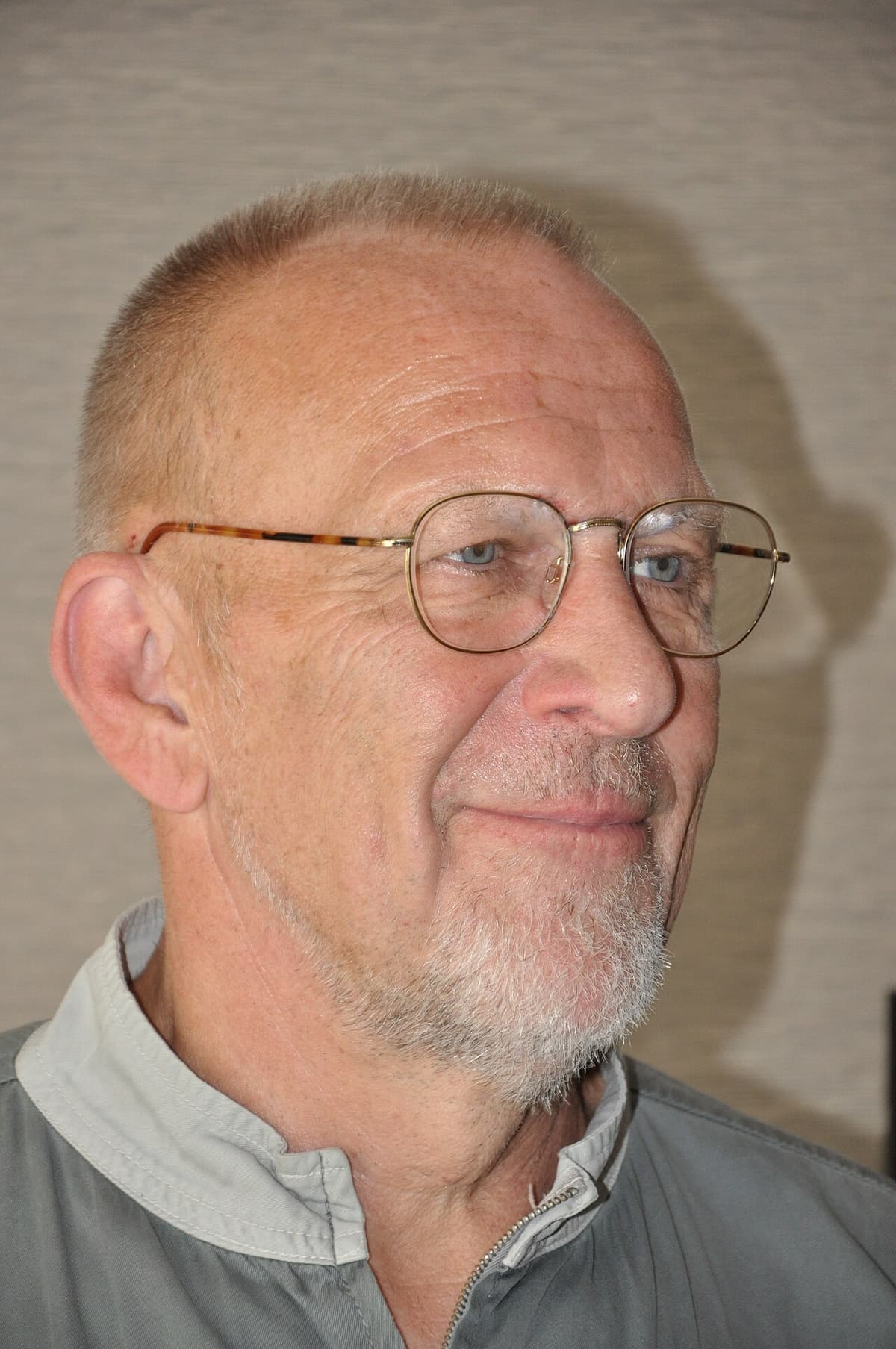
Peter Michael Hamel
Hypnotic, slow-blooming piano and organ compositions that bridge Western minimalism and Eastern spirituality. Deeply patient music for inner exploration.
Hypnotic, slow-blooming piano and organ compositions that bridge Western minimalism and Eastern spirituality. Deeply patient music for inner exploration.
Peter Michael Hamel creates music that feels like a physical space for the mind to inhabit. It is built on the principles of minimalism, but unlike the often rigid or mechanical pulse of American minimalists, Hamel’s work possesses a breathing, organic quality. His compositions often center on the piano or pipe organ, using repetitive, interlocking patterns that slowly shift and evolve, creating a sense of suspended time. There is a profound stillness at the heart of his sound, even when the notes are moving quickly.
What distinguishes Hamel is his deep integration of non-Western musical philosophies, particularly Indian classical traditions, into a European avant-garde framework. He doesn't just borrow scales; he adopts a different relationship with time and ego. His use of live electronics and prepared piano adds a layer of shimmering, otherworldly texture to his acoustic foundations, resulting in a sound that is both ancient and futuristic. It is music designed for 'self-exploration,' functioning as a sonic mirror for the listener's internal state.
To experience Hamel at his most evocative, start with 'Colours of Time.' It is a masterclass in patient development, where synthesizers and keyboards weave a tapestry that feels like watching a slow-motion sunrise. For those interested in his more acoustic, sacred-leaning side, 'Bardo' offers a haunting, deep-focus journey through resonant organ and piano spaces that demand and reward total immersion.
Peter Michael Hamel (born 15 July 1947 in Munich) is a German composer. His works have been associated with the minimalist style of composition, and in the late 1970s with the New Simplicity movement. He is the son of the film director Peter Hamel. Hamel studied musical composition, psychology and sociology in Munich and Berlin with teachers including Günter Bialas and Carl Dahlhaus. He then continued his education abroad, spending several extensive periods in Asia. In 1970, he founded "Between", an international group dedicated to improvisational music with whom he made 6 records on the intuition/WERGO label and in 1978 in Munich, he founded the Freies Musikzentrum, an institute for musical education and therapy. In 1978, his book Through Music to the Self was published in English translation, obtaining wide circulation in Europe and the U.S. Between 1997 and 2012, he was professor for composition at the Hochschule für Musik und Theater in Hamburg. His orchestral and chamber music is published by Schott, Bärenreiter and E.R.P./Celestial Harmonies. He composed four operas, many orchestral works (e.g., Gestalt), violin and piano concertos, sacred works for soprano, choirs and orchestra (e.g., Missa); Shoah (a radio-composition about the Holocaust), chamber-music compositions (including four string quartets). He is in demand as a performing artist (piano, prepared piano, pipe organ, voice and live-electronics). His First Symphony was premiered by Sergiu Celibidache in 1988; his Second Symphony had its first performance in Munich on April 29, 2008 with the Munich Philharmonic. In 2007 Hamel's Of the Sound of Life for pianist Roger Woodward was published by Celestial Harmonies. In 2009 parts of his music theatre "last minute" on Near Death Experiences has been premiered in musica viva. American minimalist composer Terry Riley has said: ...Peter's heart did not seem to be aligned alone with the post Webern traditions that had emerged so prevalently in Germany. His sensibilities were attracted more to American minimalism and Indian music and to some degree Rock and Jazz. In this sense he stands apart in the field of modern music of Germany. He has recognized the vast importance of improvisation and being "in the moment" in music performance. He realizes the importance of experimentation and of finding new ways to notate his ideas. However, his music is at the same time rooted in the great German tradition and today he is recognized as a major figure whose compositions have greatly enriched the development of 20th and 21st century repertoire....
Cassette uses generative AI to enrich its catalog. How we use AI →


