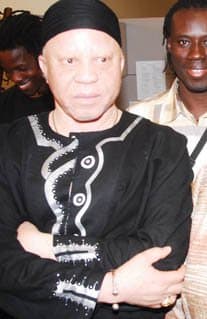
Salif Keita
Soaring, high-tension vocals meeting deep West African grooves. A majestic blend of traditional Mande instruments and lush, global pop production.
Soaring, high-tension vocals meeting deep West African grooves. A majestic blend of traditional Mande instruments and lush, global pop production.
Salif Keita’s music is a masterclass in emotional scale. It possesses a regal, widescreen quality that feels both ancient and cutting-edge. His voice, often called the 'Golden Voice of Africa,' has a piercing, high-tenor intensity that can cut through a dense thicket of electric guitars and traditional kora strings with startling clarity. It is music that feels like it was recorded in a space with infinite headroom, where every percussion hit and horn blast is imbued with a sense of purpose and history.
What truly sets Keita apart is the tension between his royal lineage and his history as a social outcast. This translates into a sound that is fiercely defiant yet deeply spiritual. He successfully bridged the gap between the big-band 'Rail Band' era of the 1970s and the high-gloss global pop of the 1990s, integrating synthesizers and drum machines without ever losing the organic heartbeat of Malian tradition. His arrangements are often complex, featuring interlocking polyrhythms that create a hypnotic, driving energy.
For those new to his catalog, starting with the 1991 album 'Amen' is essential. Produced by Joe Zawinul, it represents the peak of his global fusion era, where jazz-inflected arrangements meet his most powerful vocal performances. It is an album that demands full attention, rewarding the listener with a sense of profound catharsis and rhythmic sophistication.
Salif Keïta (IPA: [salif keita]) (born 25 August 1949) is a Malian singer-songwriter, referred to as the "Golden Voice of Africa". He is a member of the Keita royal family of Mali.
Cassette uses generative AI to enrich its catalog. How we use AI →


