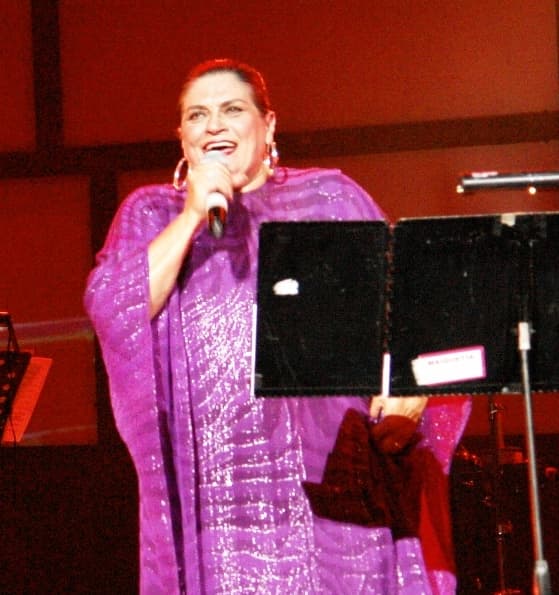
Soledad Bravo
Powerful, earth-shaking vocals that bridge the gap between Spanish folk, Caribbean salsa, and political protest. Music for deep reflection and fierce conviction.
Powerful, earth-shaking vocals that bridge the gap between Spanish folk, Caribbean salsa, and political protest. Music for deep reflection and fierce conviction.
Soledad Bravo possesses a voice that feels like it was forged in the earth and tempered by the wind. It is a massive, resonant instrument that can shift from the delicate, haunting trills of Sephardic laments to the brassy, rhythmic fire of a Caribbean salsa orchestra without losing an ounce of its soul. Her music is a map of the Latin American experience, carrying the weight of exile, the heat of the tropics, and the sharp edge of social justice.
What makes her truly distinctive is her ability to inhabit multiple cultural identities simultaneously. As a daughter of Spanish exiles in Venezuela, she blends the austere beauty of Iberian folk with the polyrhythmic complexity of South American traditions. Her delivery is often theatrical but never artificial, possessing a raw, communicative power that makes even her most political songs feel like intimate confessions.
To understand her range, start with her Sephardic songs for their haunting historical depth, then pivot to her 1980s tropical work to hear how that same voice can command a dance floor. She is the essential bridge between the folk-driven 'Nueva Canción' movement and the sophisticated pop and salsa that followed.
Soledad Bravo (born January 1, 1943) is a Venezuelan singer. Born in Logroño, La Rioja, Spain, her father was a Spanish republican, moving to Venezuela with his family when his daughter was still at an early age. At 24, Soledad began studying architecture and philosophy at the Universidad Central de Venezuela, where she also began performing. One year later, in 1968, she released her debut titled Soledad Bravo Canta (Soledad Bravo Sings), which made her a star in Venezuela and other parts of South America. In the years that followed, she cooperated with Atahualpa Yupanqui, Gilberto Gil and others, having lived and performed in Europe and the Americas. Her repertoire is a vivid mixture of fiery, vivid Caribbean and Latin rhythms, Sephardic elegies and heartwarming ballads. Considered to be one of the best voices in Latin America, one of her most popular and best known songs is Hasta Siempre, a cover of a Cuban hymn by Carlos Puebla to Ernesto "Che" Guevara.
Cassette uses generative AI to enrich its catalog. How we use AI →


