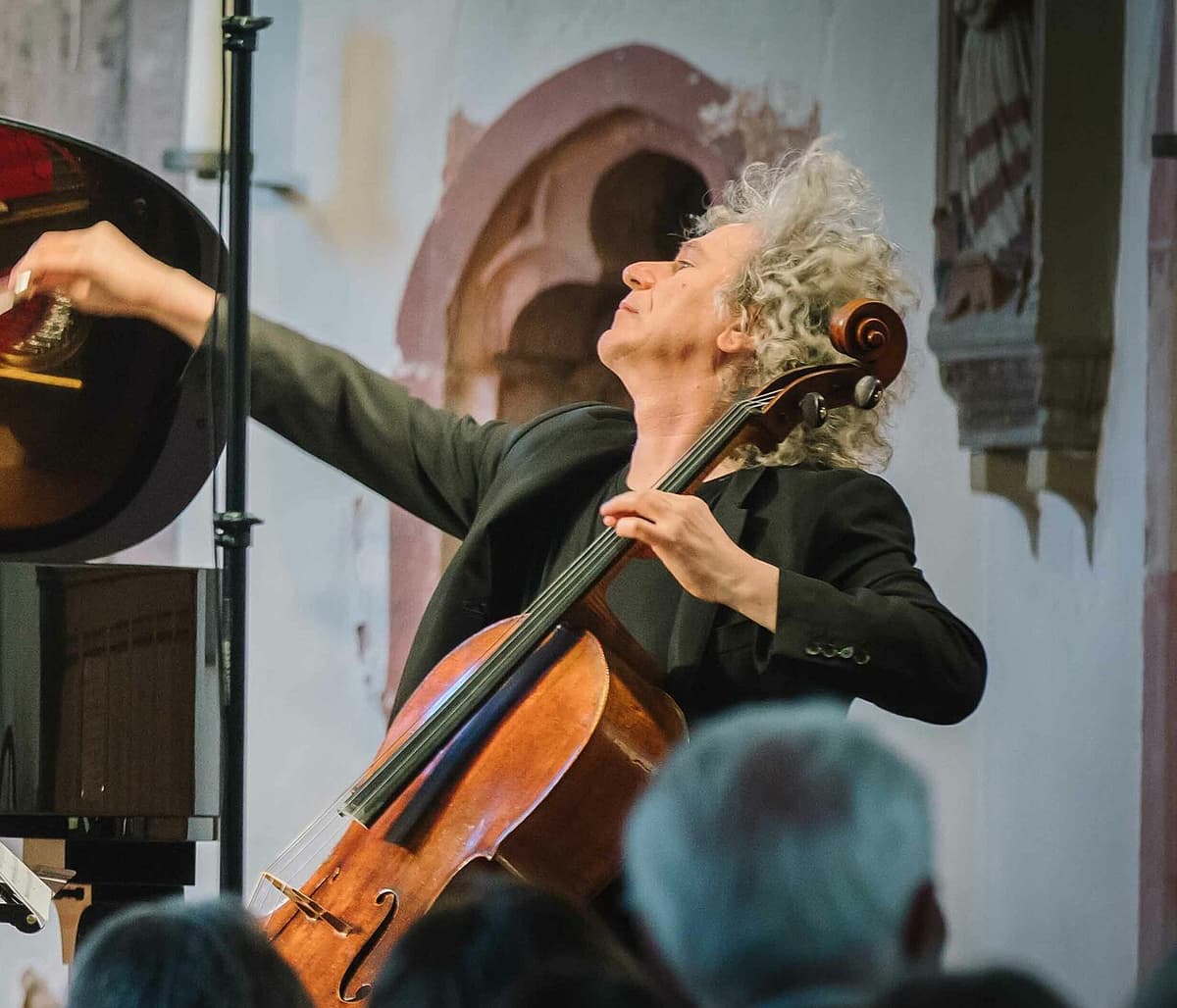
Steven Isserlis
Warm, human, and deeply expressive cello performances played on gut strings. Intellectual rigor meets a singing, vocalic tone for quiet, focused moments.
Warm, human, and deeply expressive cello performances played on gut strings. Intellectual rigor meets a singing, vocalic tone for quiet, focused moments.
Listening to Steven Isserlis is like engaging in a profound conversation with a very wise, very gentle friend. His sound is immediately recognizable for its warmth and lack of metallic edge, a result of his commitment to gut strings. It is a sound that breathes, sighs, and speaks with a vocalic quality that most instrumentalists spend a lifetime chasing. There is no ego in the playing, only a deep, scholarly devotion to the composer's intent, delivered with a lightness of touch that makes even the most complex Bach or Schumann feel intimate.
What sets Isserlis apart is his restless curiosity. He doesn't just play the hits; he is a musical archaeologist, digging up forgotten gems from the 19th century or championing contemporary works that share his lyrical sensibility. His phrasing is famously elastic, following the natural contours of a human voice rather than a rigid metronome. This gives his recordings a sense of spontaneity and life, as if the music is being composed in the very moment you hear it.
For those new to his work, his 2007 recording of the Bach Cello Suites is an essential starting point, offering a more human and less monolithic take on these pillars of the repertoire. If you want something more evocative, 'The Cello in Wartime' showcases his ability to weave historical narrative and deep emotion into a single, cohesive listening experience. It is music for the head and the heart in equal measure.
Steven John Isserlis (born 19 December 1958) is a British cellist. An acclaimed soloist, chamber musician, educator, writer and broadcaster, he is widely regarded as one of the leading musicians of his generation. He is also noted for his diverse repertoire and distinctive sound which is partly from his use of gut strings. Isserlis has been the recipient of numerous awards including the Royal Philharmonic Society Music Award in 1993, the Robert Schumann Prize of the City of Zwickau in 2000, and both the Wigmore Hall Medal and Glashütte Original Music Festival Award in 2017. His recordings have garnered two Gramophone Awards, a Classical BRIT Award, a BBC Music Magazine Award, and two Grammy Award nominations among others. He is also one of the only two living cellists inducted into the Gramophone Hall of Fame. Isserlis currently plays on the 1726 Marquis de Corberon cello made by Antonio Stradivari on loan from the Royal Academy of Music.
Cassette uses generative AI to enrich its catalog. How we use AI →


