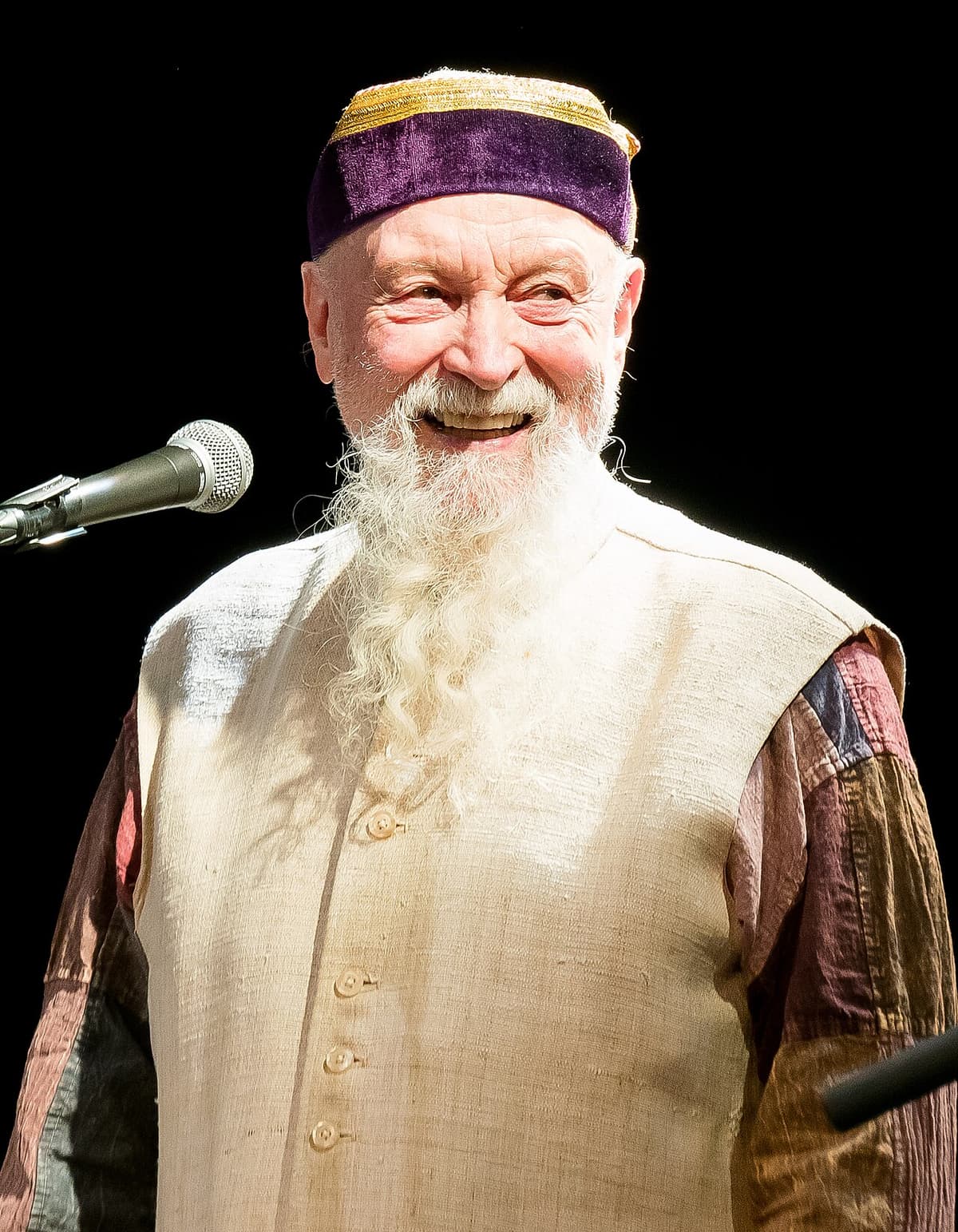
Terry Riley
Hypnotic, shimmering cycles of organ and tape loops that bridge the gap between Indian raga and psychedelic bliss. The sound of time folding in on itself.
Hypnotic, shimmering cycles of organ and tape loops that bridge the gap between Indian raga and psychedelic bliss. The sound of time folding in on itself.
Terry Riley creates music that feels like a living, breathing organism. It is built on the principle of the 'loop' long before digital technology made it easy, using tape delays and repetitive melodic cells to create a sense of infinite expansion. His sound is characterized by a bright, kaleidoscopic energy that avoids the coldness often associated with academic composition. Instead, it glows with a human, improvisational warmth.
What truly sets Riley apart is his deep immersion in Hindustani classical music. Unlike his minimalist peers who often focused on mathematical precision, Riley’s work incorporates the fluid, microtonal nuances of the raga and the rhythmic complexity of the tabla. This fusion results in a 'psychedelic' quality where the listener loses track of beginning and end, caught in a swirling vortex of shimmering organ pulses and soprano sax trills.
Start with 'A Rainbow in Curved Air' for a masterclass in solo overdubbing and joyful, cosmic energy. Then, move to 'In C' to hear the foundational text of minimalism, a piece where a simple set of 53 musical phrases creates a different, shimmering tapestry every time it is performed by a new ensemble.
Terrence Mitchell Riley (born June 24, 1935) is an American composer and performing musician best known as a pioneer of the minimalist school of composition. Influenced by jazz and Indian classical music, his work became notable for its innovative use of repetition, tape delay systems, and improvisation. His best known works are the 1964 composition In C and the 1969 album A Rainbow in Curved Air, both considered landmarks of minimalism and important influences on experimental music, rock, and contemporary electronic music. Raised in Redding, California, Riley began studying composition and performing solo piano in the 1950s. He befriended and collaborated with composer La Monte Young, and later became involved with both the San Francisco Tape Music Center and Young's New York collective, the Theatre of Eternal Music. A three-record deal with CBS in the late 1960s brought his work to wider audiences. In 1970, he began intensive studies under Hindustani singer Pandit Pran Nath, whom he often accompanied in performance. Subsequent works such as Shri Camel (1980) explored just intonation. He has collaborated frequently throughout his career, most extensively with chamber ensemble the Kronos Quartet and his son, guitarist Gyan Riley.
Cassette uses generative AI to enrich its catalog. How we use AI →


