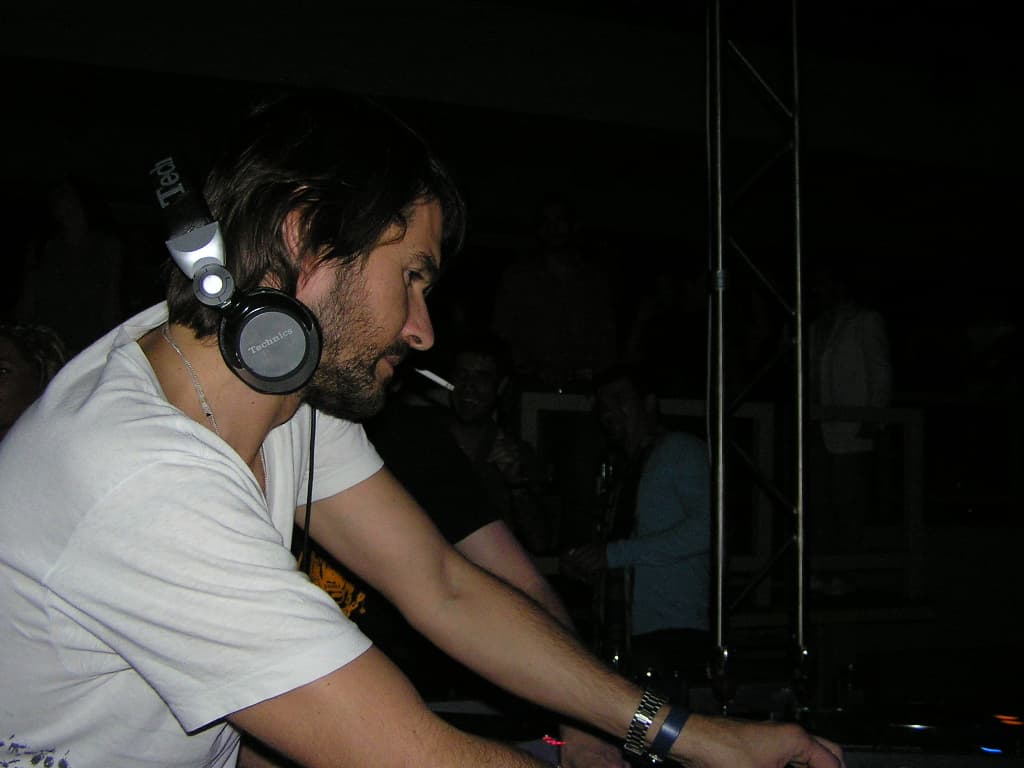
Tiefschwarz
Sleek, noir-tinted house music with a mechanical edge. Gritty electro textures meet deep, driving rhythms for the darkest hours of the urban night.
Sleek, noir-tinted house music with a mechanical edge. Gritty electro textures meet deep, driving rhythms for the darkest hours of the urban night.
Tiefschwarz sounds like the intersection of a high-end fashion runway and a damp, concrete basement club. It is music that wears sunglasses at night, defined by a polished yet aggressive digital sheen that feels both expensive and dangerous. The rhythms are relentless and precise, often utilizing metallic percussion and sharp, stuttering synth lines that cut through the mix like a laser. It captures the specific tension of a city that never sleeps, balancing the warmth of their deep house roots with the cold, jagged edges of 2000s electro-clash.
What makes them distinctive is their ability to make 'deep' sound 'sharp.' While many of their contemporaries in the German scene leaned into either pure minimalism or soulful house, the Schwarz brothers carved out a middle ground of high-fidelity grit. Their tracks often feature heavily processed, almost robotic vocal snippets that act more as rhythmic elements than melodic leads, creating a sense of mechanical soul. The production is dense and layered, yet every sound feels surgically placed to maximize the impact on a large sound system.
For those looking to dive in, 'Eat Books' is the essential starting point. It perfectly encapsulates their mid-2000s peak where they bridged the gap between indie-dance and serious club techno. It is the sound of a very specific era in Berlin and London nightlife, where the music was as stylish as the people dancing to it. If you want something more focused on the pure DJ experience, their 'Fabric 29' mix provides a masterclass in building late-night tension.
Tiefschwarz (German pronunciation: [tiːf.ʃʋaʁts]) are a German house group consisting of brothers, Alexander "Ali" (June 7, 1967) and Sebastian "Basti" (December 28, 1969) Schwarz, which formed in Stuttgart in 1996. Peter Hoff, who runs the Benztown studios in Stuttgart, joined later, and completed the first Tiefschwarz production team. Their name means "deep black" in German, and is a combination of the brothers' surnames, and their love of deep house. Their earliest productions were released on the Continuemusics label in 1997, and their first taste of a well-respected label was with their Music track on François Kevorkian's Wave Music label in 1999. The team released their first album, RAL9005 on the Four Music label in 2001, which was later licensed to Derrick Carter and Luke Solomon's Classic Recordings label. Tiefschwarz continued to release on Classic until its collapse in 2005, as well as releasing on labels such as Fine and International DeeJay Gigolo Records. Many of their tracks have been licensed to compilations, from the Stereo Sushi series, to compilations for Bugged Out!, Get Physical and Renaissance, and in 2006, they released a mix of their own for the Fabric (London) mix series. Their sound has been described as both deep, mellow house, and gritty, edgy electro house, their tracks having gained recognition from the likes of Ivan Smagghe, Touché, Sasha and Danny Howells. Ali and Basti Schwarz have been travelling Europe as DJs since 1995, playing at major events and popular clubs all over Germany and Switzerland, as well as making appearances in Ibiza. They've performed in cities as far afield as Miami, New York, Melbourne, Sydney, Amsterdam, Sarajevo, London, Antwerp and Stockholm. Tiefschwarz have composed remixes for Madonna's Get Together, Missy Elliott's Teary Eyed and Depeche Mode's single, John the Revelator. 2007 sees a return to a deeper house sound as shown in their 10 years anniversary compilation; 10 Years Of Blackmusik. In January and July 2011 Tiefschwarz performed at the legendary aftershow party of the StyleNite, a cultural event of the designer Michael Michalsky during Berlin Fashion Week.
Shares minimal techno (subgenres); brooding, mysterious, energetic (moods)
Shares processed, deadpan, whispered (vocal style); brooding, mysterious, energetic (moods)
Shares minimal techno (subgenres); urban night, basement show, late night (atmosphere)
Shares studio polished, digital clarity, layered dense (production style); processed, deadpan, whispered (vocal style)
Shares minimal techno (subgenres); mysterious, energetic, tense (moods)
Shares minimal techno (subgenres); studio polished, digital clarity, layered dense (production style)
Shares minimal techno (subgenres); studio polished, digital clarity, compressed loud (production style)
Shares studio polished, digital clarity, layered dense (production style); urban night, basement show, late night (atmosphere)
Shares minimal techno (subgenres); urban night, basement show, late night (atmosphere)
Shares minimal techno (subgenres); urban night, basement show, late night (atmosphere)
Shares electro house, metallic, minimal techno, tense (signature)
Shares minimal techno, whispered, absent, late night (subgenre)
Cassette uses generative AI to enrich its catalog. How we use AI →


