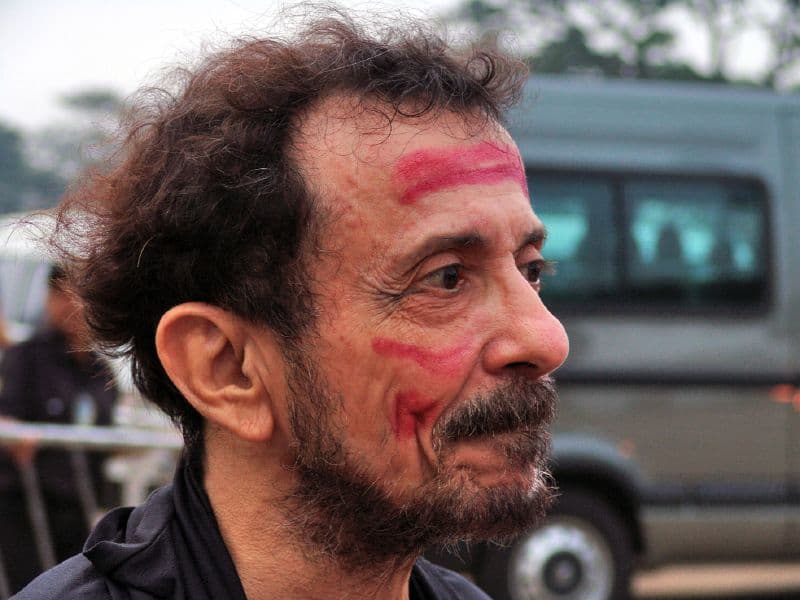
Tom Zé
Deconstructed samba and found-object pop from a Brazilian iconoclast. Playful, dissonant, and deeply intellectual music for curious minds and restless ears.
Deconstructed samba and found-object pop from a Brazilian iconoclast. Playful, dissonant, and deeply intellectual music for curious minds and restless ears.
Tom Zé sounds like a clockmaker who decided to build a carnival out of spare parts. His music is a fascinating collision of traditional Brazilian rhythms like samba and forró with the jagged edges of avant-garde experimentation. You will hear the warm, familiar strum of an acoustic guitar suddenly interrupted by the rhythmic clatter of a typewriter or the grinding of industrial tools. It is music that feels handmade, tactile, and brilliantly disorganized, yet it possesses a deep, underlying logic that reveals itself over repeated listens.
What truly sets Zé apart is his 'Dadaist' approach to the pop song. While his Tropicalia peers often leaned into lush psychedelia, Zé remained a provocateur, using dissonance and concrete poetry to poke at social norms and musical expectations. He treats the studio as a laboratory, layering deadpan vocals over polytonal harmonies and unusual time signatures. There is a persistent sense of irony and wit in his delivery, making the music feel like a series of clever musical jokes that are also profound cultural critiques.
For the uninitiated, 'Estudando o Samba' is the essential starting point. It is a conceptual masterpiece that takes the heart of Brazilian music and turns it inside out. From there, the David Byrne-curated 'Brazil Classics 4' provides a perfect overview of his most accessible yet still wonderfully weird moments. Listen when you want music that demands your full attention and rewards your curiosity with sounds you have never heard before.
Antônio José Santana Martins (born 11 October 1936), known professionally as Tom Zé (Portuguese pronunciation: [ˈtõ ˈzɛ]), born in Irará, Bahia, is a Brazilian singer-songwriter, multi-instrumentalist, and composer who was influential in the Tropicália movement of 1960s Brazil. After the peak of the Tropicália period, Zé went into relative obscurity: it was only in the 1990s, when musician and Luaka Bop label head David Byrne discovered Zé's 1975 album Estudando o Samba and then released reissues of his work, that Zé returned to performing and releasing new material.
Cassette uses generative AI to enrich its catalog. How we use AI →


