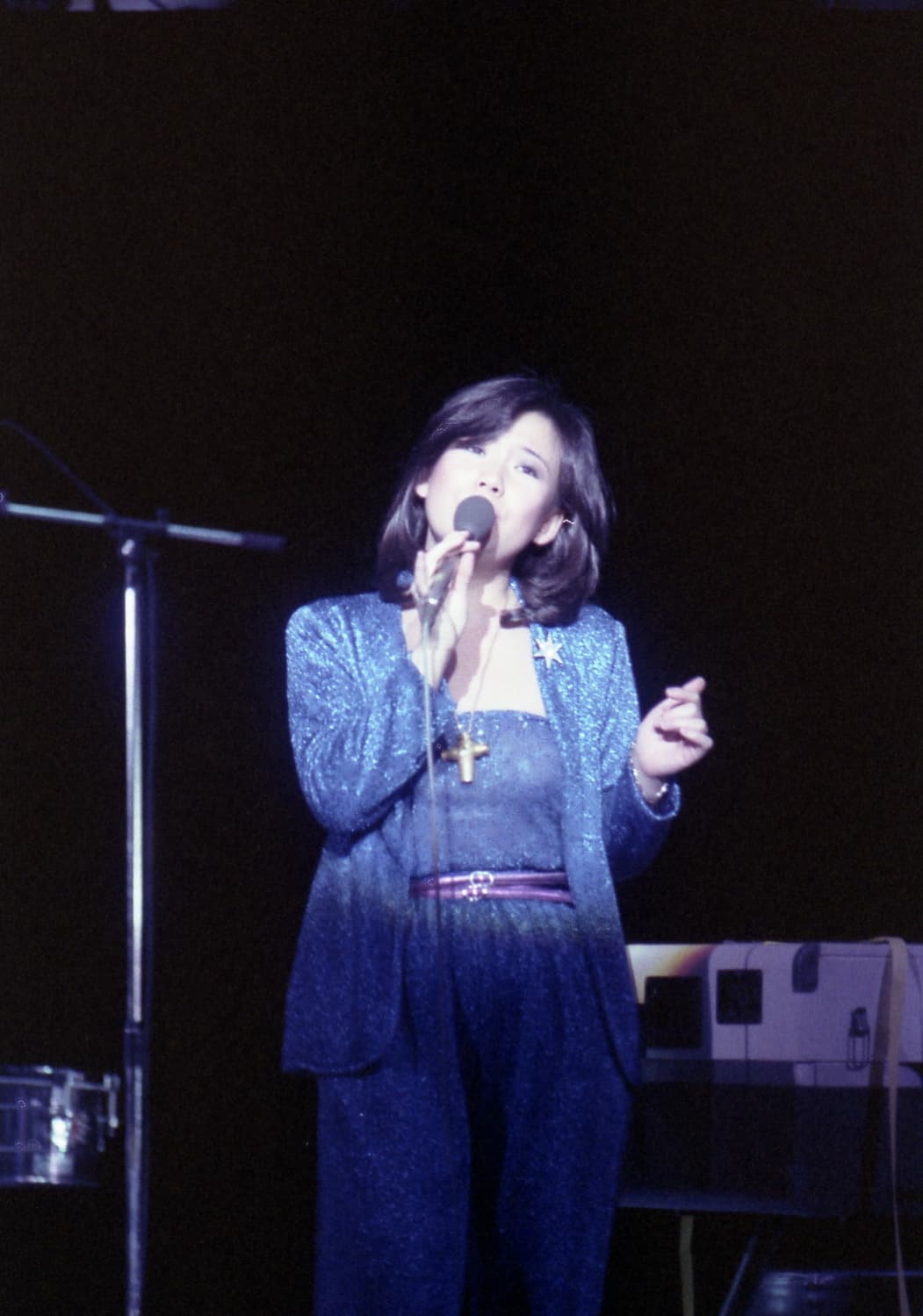
Yasuha captures the peak of Japan's economic bubble era through a lens of pure, unadulterated sonic optimism. Her music is a masterclass in the 'City Pop' aesthetic, characterized by expensive-sounding studio production, tight rhythm sections, and a sense of cosmopolitan adventure. It feels like a high-definition postcard from 1981, saturated with color and movement.
What sets her apart is the sheer power and technical precision of her voice. Unlike some of her more breathy contemporaries, Yasuha possesses a robust, clear-toned delivery that can cut through dense arrangements of horns and synthesizers. Her signature hit 'Fly-Day Chinatown' exemplifies this, blending exotic melodic scales with a driving disco beat that feels both sophisticated and immediately accessible.
Start with her 1981 debut single and the album 'Transit' or 'Blue Night Blue'. These records represent the gold standard of the genre, offering a perfect entry point for anyone looking to understand why 80s Japanese pop has found a massive new global audience decades later.
Yasuha Ebina (海老名 泰葉; born January 17, 1961), known professionally as Yasuha, is a Japanese singer-songwriter, tarento, record producer, and entrepreneur. Ebina's personal life has often sparked controversy and received widespread media coverage. As well as her singing career, she was also successful as a tarento, appearing in numerous Japanese television and radio programs. Ebina was born in Taitō, Tokyo as a child of rakugo performer Hayashiya Sanpei I and novelist Kayoko Ebina. She established her singing career in 1981. As singer, Ebina is best-known for "Fly-Day Chinatown" (1981), which peaked at number sixty-nine on the Oricon Weekly Singles Chart. She also embarked on the tarento career, appearing in the Japanese variety television program Gogo wa MaruMaru Omoikkiri TV (1987–1988) as a host. In 1988, Ebina retired from the entertainment business after her marriage with rakugo performer Shūnpūtei Koasa. After a messy divorce with her ex-husband, Ebina officially returned to the entertainment industry in 2007, founding the production company Iron Candle.


Shares euphoric, energetic, confident (moods); belting (vocal style)
Shares belting (vocal style); disco, funk (subgenres)
Shares studio polished, analog warmth, orchestral arrangement (production style); disco, synth-pop (subgenres)
Shares disco, funk (subgenres); studio polished, analog warmth, orchestral arrangement (production style)
Shares disco, funk, synth-pop (subgenres); euphoric, energetic, confident (moods)
Shares disco, funk, synth-pop (subgenres); euphoric, playful, energetic (moods)
Shares disco, funk, synth-pop (subgenres); studio polished, analog warmth, hi fi (production style)
Shares euphoric, energetic, nostalgic (moods); studio polished, analog warmth, hi fi (production style)
Shares euphoric, energetic, confident (moods); studio polished, analog warmth, orchestral arrangement (production style)
Shares disco, funk, synth-pop (subgenres); studio polished, analog warmth, hi fi (production style)
Shares euphoric, belting, disco, funk (signature)
Shares city pop, disco, funk, euphoric (signature)
Cassette uses generative AI to enrich its catalog. How we use AI →