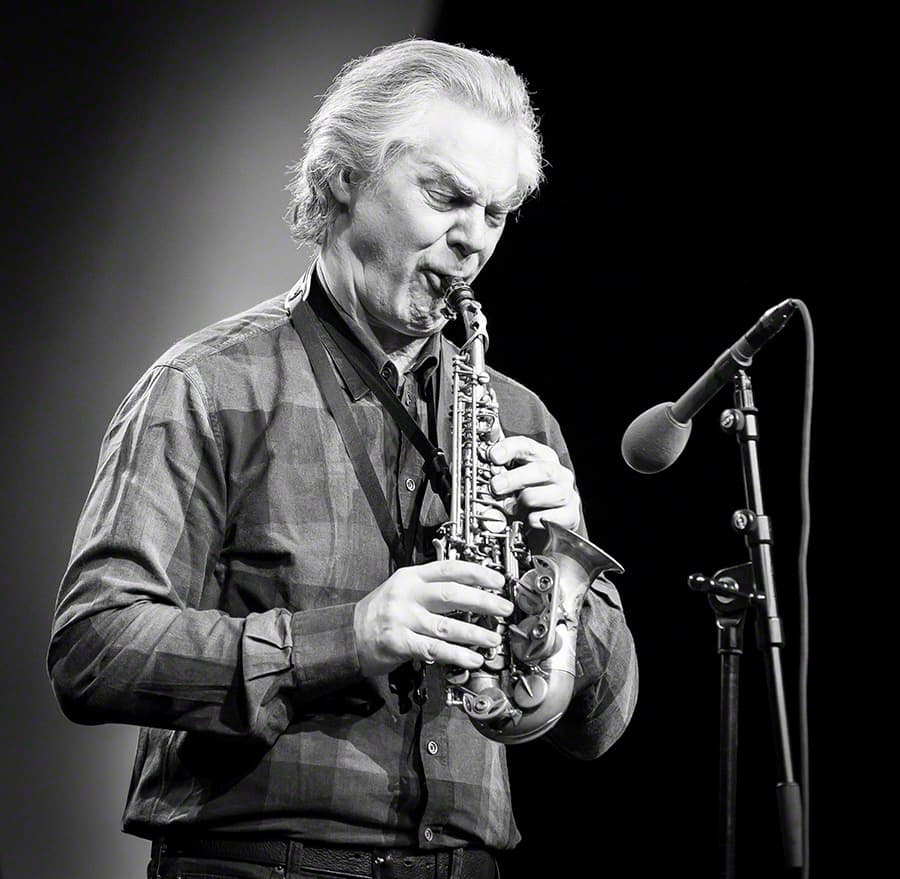
Jan Garbarek
Icy, spacious saxophone lines that feel like a cold wind across a fjord. Meditative jazz that uses silence as an instrument. Perfect for deep focus and solitude.
Icy, spacious saxophone lines that feel like a cold wind across a fjord. Meditative jazz that uses silence as an instrument. Perfect for deep focus and solitude.
Jan Garbarek is the primary architect of the 'Nordic Tone' in jazz, a style characterized by spatial awareness, folk-inflected melodies, and a departure from American blues-based improvisation. Emerging from the late 60s avant-garde scene under the tutelage of George Russell, Garbarek eventually stripped away the dissonance of his early Ayler-influenced work to develop a crystalline, sharp-edged soprano and tenor sound.
His career is inextricably linked with Manfred Eicher's ECM Records, where he helped define the label's 'most beautiful sound next to silence' philosophy. Garbarek's influence extends beyond jazz into the 'World Music' and 'New Age' booms of the 80s and 90s, notably through his cross-cultural collaborations and his massive commercial success with the Hilliard Ensemble on 'Officium,' which paired his saxophone with 16th-century polyphony. Critics often highlight his 'sculptural' approach to phrasing, where the timbre and decay of a single note carry as much weight as a complex harmonic progression.
Shares spiritual jazz, contemplative, avant-garde jazz, field_recordings (subgenre)
Shares spiritual jazz, contemplative, avant-garde jazz, field_recordings (subgenre)
Shares spiritual jazz, reverb_heavy, mountain, field_recordings (subgenre)
Shares glacial, neoclassical, reverb_heavy, mountain (signature)
Cassette uses generative AI to enrich its catalog. How we use AI →