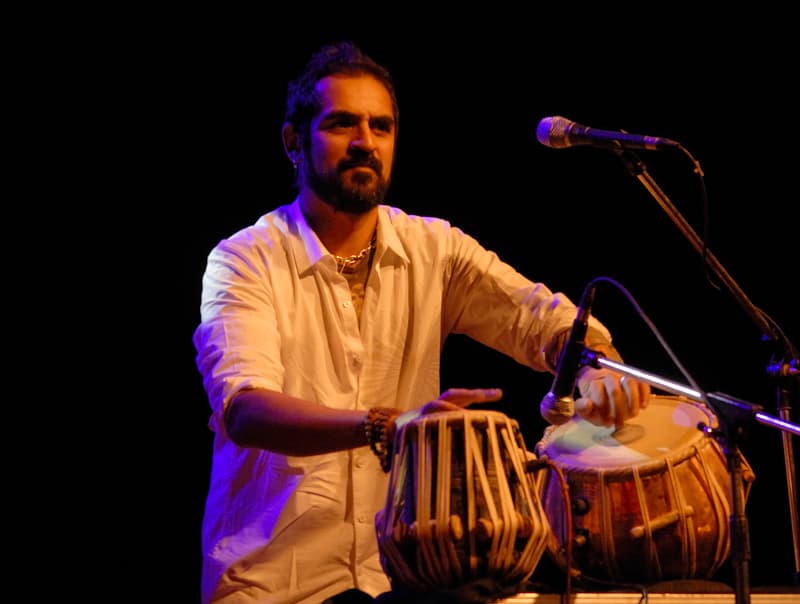
Karsh Kale
Deeply textured fusion of classical Indian percussion and murky late-night electronica. Cinematic, rhythmic, and perfect for urban solitude.
Deeply textured fusion of classical Indian percussion and murky late-night electronica. Cinematic, rhythmic, and perfect for urban solitude.
Karsh Kale creates a sound that feels like a bridge between ancient spiritual traditions and the cold, flickering lights of a modern metropolis. At its core is the tabla, but it is rarely played straight; instead, it is chopped, layered, and woven into thick tapestries of trip-hop beats and soaring ambient synths. The music has a liquid quality, flowing effortlessly between organic instrumentation and digital manipulation.
What truly sets him apart is his ability to treat the tabla not just as a rhythm instrument, but as a melodic and atmospheric force. While his peers in the Asian Underground scene often leaned into dancefloor energy, Kale’s work frequently retreats into a more introspective, cinematic space. There is a persistent sense of 'longing' in his melodies, often carried by haunting vocals or bowed strings that cut through the electronic haze.
Start with 'Breathing Under Water' for a masterclass in collaborative fusion, then dive into 'Realize' to hear the foundational blueprint of his signature tabla-electronica sound. It is music for the moments when you want to feel both grounded in history and untethered from the present.
Karsh Kale (pronounced Kursh Kah-lay, कर्ष काळे in Marathi; born 1 November 1974) is an Indian-American Musician and Producer who is known primarily for his experimental tabla playing within electronic music contexts. Kale's career has seen him take on roles of an Indian classical tabla player, singer, songwriter, film and TV score composer and DJ. He is considered a pioneer of the Asian Underground genre, bringing elements of Indian music to Electronica and Dance. His career highlights include touring as the supergroup Tabla Beat Science (with Ustad Zakir Hussain, Bill Laswell, Ustad Sultan Khan et al.), 6 solo studio records from 1999 (several other record appearances), the seminal 2007 album "Breathing Under Water" with Anoushka Shankar, scoring and production for the 2019 Bollywood smash hit "Gully Boy", curating 6 acclaimed songs for the Indian Coke Studio in 2012, amongst many others. Kale is also popular for his eclectic collaborations with Sting, Ustad Zakir Hussain, Ustad Sultan Khan, U2, Norah Jones, Yoko Ono, and Herbie Hancock to name a few.
Shares layered dense, analog warmth, sample based (production style); mysterious, contemplative, restless (moods)
Shares trip-hop, downtempo, ambient techno (subgenres); layered dense, analog warmth, sample based (production style)
Shares downtempo, ambient techno, trip-hop (subgenres); layered dense, analog warmth, sample based (production style)
Shares trip-hop, downtempo, ambient techno (subgenres); layered dense, analog warmth, sample based (production style)
Shares mysterious, contemplative, restless (moods); sample based, reverb heavy, layered dense (production style)
Shares layered dense, analog warmth, sample based (production style); trip-hop, downtempo, ambient techno (subgenres)
Shares trip-hop, downtempo, ambient techno (subgenres); layered dense, analog warmth, sample based (production style)
Shares trip-hop, downtempo, ambient techno (subgenres); mysterious, contemplative, restless (moods)
Shares trip-hop, downtempo, ambient techno (subgenres); layered dense, analog warmth, sample based (production style)
Shares trip-hop, downtempo, ambient techno (subgenres); reverb heavy, layered dense, analog warmth (production style)
Shares trip-hop, train ride, chanting, soulful (signature)
Shares trip-hop, underwater, ambient techno, downtempo (signature)
Cassette uses generative AI to enrich its catalog. How we use AI →


